

The Welsh Norwegian Society Open to all with an interest in Norway
NEWSLETTER Issue 1 Volume 8 Spring 2004
Welcome to the Spring newsletter, and thank you for the positive response to the Winter newsletter.
New members have joined us in the last few months, and we hope that they will feel welcome in our company and will enjoy the exchange of information on Welsh/Norwegian matters.
Since the last newsletter, we have celebrated Christmas in the Norwegian church, with the Christmas market, the tree-lighting ceremony and our Christmas dinner, where we maintained the tradition of singing and dancing around the tree. In January, Alan Hall presented an absorbing account of Atlantic College and its sister college in Norway and, in February, Peter Persen challenged us to a Scandinavian quiz. Our March meeting was an opportunity to welcome friends to join us in sampling Norwegian cheeses, accompanied by wine. Please continue to send in articles and suggestions for the newsletter.
Many thanks, Mary Allen
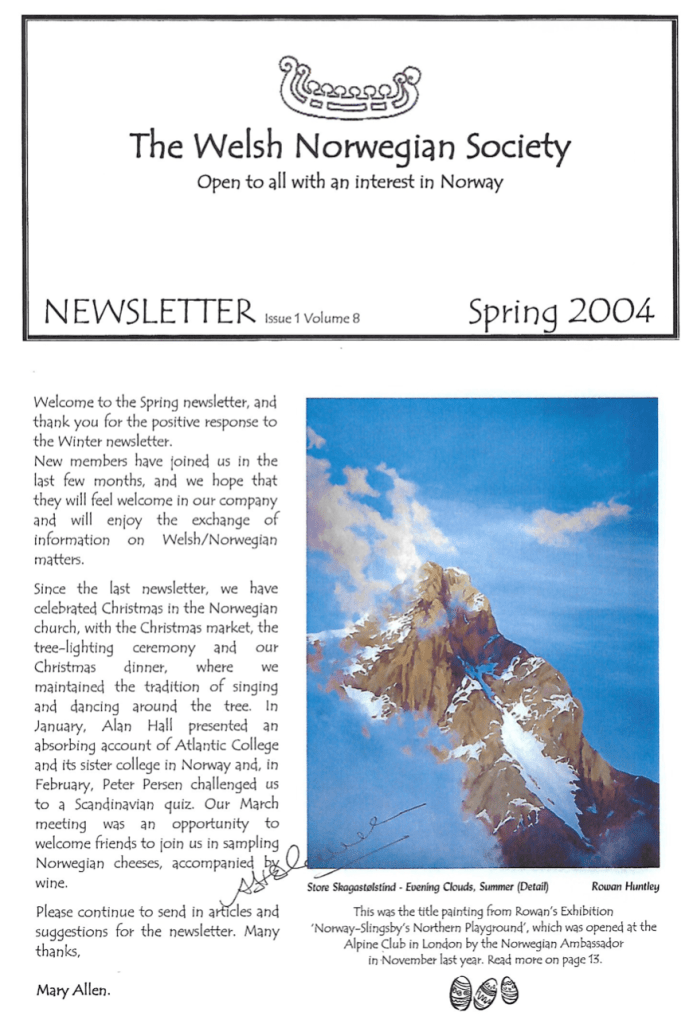
[Image: Lis Store Skagastalstind – Evening Clouds, Summer (Detail) Rowan Huntley]
This was the title painting from Rowan’s Exhibition, Norway-Slingsby’s Northern Playground’, which was opened at the Alpine Club in London by the Norwegian Ambassador in November last year. Read more on page 13.
Dear Members
First let me welcome all the new members to our Society and to say thank you to everybody for attending the various events we have put on since our last newsletter
Mary Allen willingly took over the Newsletter job from Rowan after the September A.G.M. but has recently found herself with another task i.e. purchasing wine and borrowing glasses from Tesco on our behalf, for use during our Quiz and Cheese and Wine nights. THANK YOU MARY.
Looking forward to seeing you all at future events,
Sincerely, Averil Goldsworthy (Chairman).
NORWAY/CARDIFF – a true story of long-term friendships from long ago.
By Averil Goldsworthy
In 1939 war was declared and it was not too long before Cardiff Docks became a target for enemy bombers. All over the country, people were asked to keep their factories working twenty four hours a day by working shifts, but for Cardiff Docks this work pattern was no change, as being such a tidal port ships came in and out for repair, refuelling, food supplies etc., at all times of the day and night. Because of the war however, Dockers worked extra hard often receiving a ship in on one tide and turning it back out on the next.
Some men sent their wives and children across the channel to Somerset to avoid the danger of bombing. Sidney (Sid) Smith was such a man. He remained in Cardiff because he worked as a representative for Evans Foundry situated in the Roath Dock. Many Norwegian ships came regularly in and out of the docks and Sid immediately made contact with their Captains with a view to getting foundry business from them. Grenville (Gren) Smith, Sid’s older son remembers his Dad visiting the family in Somerset and telling him stories about the Norwegian ships and their sailors amongst whom he had made many friendships. This was the beginning of years of sincere friendships with Norwegian people.
As time went on, Evans Foundry took over McCulhams Foundry, renamed themselves The Bristol Channel Foundry and moved from the Roath Dock to Roath Basin alongside the Norwegian Church. We still have a photograph of the Norwegian Church and the Foundry on the wall of the Church. Sid became a frequent visitor in and out of the Church and a deep friendship developed between the Priest Rolf Rasmussen and Sid, who often popped into the Church in his lunch-time to eat his sandwiches, and have a cup of tea. Not only did these two men like each other as people, but apart from trade with Norwegian shipping, they also shared a second common denominator, which were their strong Christian beliefs. Father Rasmussen of course, was a professionally trained Priest, so what about Sid? At this time, there were many well-attended Churches and Chapels in the area and Sid was a well-known part time Preacher. Also, at this period it was common in the summer-time to hold open-air services, often around the bandstand in parks and on street squares. Sid had a good strong voice for this work.
Can you imagine some of the lively discussions that must have taken place over their lunchtime sandwiches over their individual interpretations of various scriptures? I can.
Again through this particular friendship Sid was introduced to Norwegian families who were members of the Church at that time and living in and around Cardiff.
At times these two men went together to visit some of the cafes in the Docks which were always full, one of the reasons being that you could get refreshments without using your precious food coupons and the other reason was it was such a good place to meet and discuss business deals. The cafes mainly used were the Kardoma, Leyshon’s and, of course, the Norwegian Café. At one time, this café was run by Mr Fiell, a Norwegian man, and his Irish wife.
The foundry continued to make FIRE BARS AND BRASS BEARINGS plus all manner of things for the Norwegian ships for many years, and eventually Sid became the Foundry Manager.
The bombing eventually subsided, and Sid brought his family back to Cardiff. Gren remembers clearly being taken to the Norwegian café and Church. He also remembers a Norwegian Captain visiting his home and showing them that sugar was better than salt on tomatoes!
In 1946 Gren himself decided to become a seafarer and began his Apprenticeship at the Reardon Smith Nautical School. His first trip was with DENE Shipping Co. who traded back and fore South America.
After the war, Mr Rasmussen and his family returned to Norway, but Sid continued to make friends with his successors. On leave from one long trip, Sid made Gren promise to visit the Church in Buenos Aires where one of the Priests who had spent time in Cardiff now had a position there. Next trip Gren did as his father had asked and visited the Church. The following is a quote from Gren.
I have never forgotten the wonderful time I spent with those Norwegian people, the care, love and hospitality they showed to me, a young man, a long way from home a person whom they had never met before. There was no food shortage there, and I remember course after course of lovely prepared food served at the Dinner table.
After all these years, I still have happy memories of these Norwegian people.
Times and Cardiff Docks changed, and eventually all Sid’s friends returned to Norway. He had many invitations to visit Norway but for a variety of reasons he never actually got there.
Gren told me that up to the time his Father died, he kept a clear memory of his close friendships with Norwegian people. His affection for these people remained strong until the end.
Photo:The Norwegian Church and Foundry
Memories
by Duncan Longden
’Hello there, just the man I want to see.’ This was the greeting I got at eight o’clock one morning early in December 1985. Cllr Paddy Kitson then got me to go down to Cardiff docks to see the Norwegian Church. The reason behind this visit was that a new road system was planned to go through where this building stood, and I was known to be interested in old buildings and was credited with determination to get things done, if possible. I was lucky to get support from the following people – Roger Allen, Don Webber, Mervyn Amundsen, Peter Persen and Terje Inderhaug. We got support from the South Wales Echo and the Western Mail. A trust was formed and registered with the Charity Commissioners, with the legal help of Nick Neal (deputy county solicitor). We managed to get a Manpower Services scheme approved to dismantle the church. I Before we could start, we had to get the remains of an old timber workshop removed and South Glamorgan County Council kindly helped by paying for the site adjoining the church to be cleared. Roger Allen helped with supervising the marking and numbering of all the dismembered timbers. Initially, all the salvaged materials were stored in a compound and then we got space in a warehouse off Bute Street. Meanwhile, we wrote to find patrons and contacted anyone who might support the work, with funds or interest.
I made an effort to raise funds by doing a walk, supported by the Western Mail. A friend and his dog accompanied me from Fairwater to Cowbridge. We were graced by the Mayor of Cowbridge on our arrival.
When the Cardiff Bay Development Corporation was formed, Sir Geoffrey Inkin became one of our patrons. We were also glad to get George Bartlett of A.S.W. and Ewart Parkinson to join us. We were also pleased when Freddie Watson from A.B.P. lent us support, as well as Ian McCarthy who helped us to gain publicity.
We were so lucky to have people who had been connected with the Norwegian Church, such as Fred Schroeter, Ebba Lovering, Mrs Greve and Howard Gough
to give us support.
It was very fortunate that Terje Inderhaug from Bergen was studying at Cardiff University at this time, and he was able to provide the link with Norway.
Also, let us not forget that Roald Dahl was our first President.
Footnote: Duncan Longden was the first Chairman of the Norwegian Church Preservation Trust. He has agreed to write another article for the next newsletter outlining more of his memories.
Are you interested in learning Norwegian?
Eller er du interessert i å prakisere din norsk?
We are hoping to organise classes for beginners and anyone else interested in improving their Norwegian. For further information, please contact: Shuna Lovering
A Sea Tale
By Jack Needs
In both the 1914-18 and 1939-45 conflicts, where mastery of the seas was of vital importance, the Cardiff Channel Dry Dock & Pontoon Company rendered invaluable service to the war effort by repairing ships speedily and skilfully.
The SS Tafelberg, a Norwegian whaling factory ship, was mined in the Bristol Channel in 4941.The explosion broke her into two halves, through the mid-ships pump room.
In a delicate operation, the two halves were beached on the sands at Barry Island. Engineers from the Channel Dry Dock made them watertight and floated the bow half into dry dock. Extensive repairs were carried out to both halves and then the stern half was floated to join the bow half. With the reconstruction of the mid-ships pump room, the two halves matched perfectly and were joined in dry dock. The ship was then completely refurbished, fitted with armament and sailed off to do war service.
[photo: the SS Tafelberg]
News in Brief
Red King Crabs
Millions of giant Pacific crabs are marching south along Norway’s coast, devouring everything in their path. The monster crabs, which can weigh up to 25lb and have a claw-span of more than three feet, are proving so resilient that scientists fear they could end up as far south as Gibraltar. According to marine experts, predicting the crab’s effect on the marine ecology is difficult but, in the meantime, it has already become an important source of income for some fishermen in the north. Other fishermen hate the crabs, blaming them for falling fish stocks and complaining that they get tangled in their nets. In recognition of the growing threat to the local ecology, Norwegian authorities have lifted some of the restrictions on crabbing along part of the shoreline. (information supplied by W. Pople ).
Cardiff News at the end of the 19% century
From Allan P. Milne’s archive collection
The Cardiff Times and South Wales weekly News
Saturday March 6 1897
Dr Nansen at Cardiff
Lecture in the Park Hall
The great Artic explorer, Dr. Nansen, accompanied by Mrs. Nansen, arrived in Cardiff from Sheffield on Saturday at 3.45p.m. Long before the arrival of the train, a vast crowd had assembled on the platform of the Great Western railway station, many of those present being Norwegians come to do honour to their national hero.
At about ten minutes after the time advertised, the train steamed into the station, and a rush was made in the direction of the carriage from which Dr. Nansen’s stalwart form was seen to emerge. Mrs. Nansen, a ruddy-faced cheerful looking lady attired in a greenish cape and dress trimmed with fur, accompanied her husband. The great explorer was received by Mr. Drane (president of the Cardiff Naturalists society), Dr. Charles Vachell and Mr. W.Cook (hon.sec.).
A terrific outburst of applause went up as Dr. and Mrs. Nansen walked along the platform, and, at the top of the steps leading to the subway, Dr. Nansen was greeted by Mr. Hansen, an uncle of Lieutenant Scot-Hansen of the Fram expedition. Mr. Hansen, in a few words, heartily expressed on behalf of the Norwegians in Cardiff, their deep sense of gratitude to him for the glory that he had earned for his native country by his successful expedition.
Dr. Nansen thanked Mr. Hansen for the expression of good wishes, and the party were escorted to the open carriage that awaited them at the Railway Approach. Here, amidst a scene of great enthusiasm, a procession was formed, headed by the Hungarian band. Immediately behind came the carriage containing Dr. and Mrs. Nansen, Mr. Drane and Mr. Charles Vachell. The procession set off at a walking pace, all the Norwegians falling in behind, and proceeding, via St. Mary Street, to the Park Hotel, where Dr. Nansen stayed during his visit………..
The lecture delivered on Saturday evening was a pronounced success. For nearly an hour and three-quarters, the great explorer held the audience spellbound…. And what an audience he addressed! It was representative of the culture, the learning, the wealth, the commerce of the Welsh metropolis, and it had moreover a certain flavour of Scandinavian patriotism, for, from all parts of South Wales, had come Norwegians to do honour to the man, who had shod (sic) upon their nation, a halo of glory not less radiant and remarkable than that which dame nature had conferred when she bestowed the aurorean beauties upon the long, silent Arctic night.
A Norwegian Tale
Contributed by Ellen Wayne
The W.C.
An English lady was going on a camping holiday to Norway and wanted to know about the toilet arrangements at the campsite, so she wrote to the campsite and asked about the W.C.s there. The camp manager didn’t know what W.C. meant to the English, so he thought about it and decided that she probably meant Wooden Church (for which Norway is famous), so he passed her request to the local minister. This is his reply to the lady:
Dear Madam,
The nearest W.C. is located two kilometres from the campsite, in a small wooded area. As it is the only W.C. in the area, it is very popular with both the locals, as well as visitors. It is open twice a week- for two hours on Wednesday and from 8.30a.m.on Sunday, but could be visited at other times, at the discretion of the key holder.
I would advise you to arrive early if you want to sit down, as there are only 35 seats, although there is room for standing, if you wish.
You must not take photos while in the W.C., and, because of the acoustics, you must not talk or make any other noise, as every sound is magnified.
I hope this is of help to you,
Yours Faithfully
Mr. Ericson.
Newsletter Contributions
Please send items for the Newsletter to:
Mary Allen
All items will be considered for publication, but it may be necessary to edit articles, on occasions. The next newsletter will be published in the Summer and the deadline is 4th June, 2004.
News in Brief
NBCC
The Norwegian British Chamber of Commerce is set to bring Norwegian exporters into direct contact with companies in the rapidly developing and commercially important North-East of England. In February, the Norwegian ambassador, Mr.Tarald Brautaset, addressed the NBCC North-East at its inaugural meeting, in Newcastle -upon-Tyne.
Crossing Fingers
According to a BBC reporter, crossing fingers for luck has Viking origins. The sign is similar to the ninth letter of the runic alphabet and means ‘Hope for the best’.
Notes from the North west
By Stan Royden
Member of the Norwegian community in the Scandinavian Seamen’s Church in Liverpool
When you decide to impose yourself on someone, you always feel a lot better if you have a good excuse. So when Mette and I decided to visit Cardiff, and the Norwegian Church in particular, we were pleased to be able to pack the ‘Shetland Bus’ exhibition into the back of our car and return it to Karen, ready for its next showing in the Welsh capital.
When we arrived at the church that chilly Sunday evening in early February, our welcome could not have been warmer; the stalwarts had prepared a veritable feast – a truly inspiring blend of Anglo-Welsh-Norse specialities. And, while we were doing justice to the delicacies on the table, we had plenty to talk about, sharing our experiences, comparing and contrasting the highs and lows of our mutual Norwegian heritage on the west coast of the U.K.
Mette and I had heard a great deal about the church in Cardiff, so we were soon exploring every nook and cranny, and most impressed we were. Two things stand out in my memory: the explanation of the symbolism of the war-sailors’ plaque (we have an identical plaque in Liverpool of course, but no explanation of the symbolism), and the oars tied in the shape of a cross, which had been found under the original church-what a poignant symbol.
Our stay was over too soon, but, with Karen’s help, we were able to take in most of the sights of the vicinity of the church before we left, taking the ‘scenic route’ back to Liverpool, in order to collect our daughter and grandchildren from Amersham, who were escaping from building work in their kitchen.
Back at the ‘ranch’, plans to set up a charitable trust for the Scandinavian church in Liverpool had at last been approved SKUT (the Swedish Church Abroad, the organisation that owns our church and provides the pastor), so our committee was, and, as I write, is busy finalising all the details: a name-LiNC (Liverpool international Nordic Community), a logo (watch this space), setting up a bank account, and so on.
Much of Liverpool is a building site at the moment, and that is certainly true of the Baltic Triangle, the area round ‘Gustaf Adolf’ (he was a Swedish king in the 17 century, and the church is named after him); old warehouses and factories are tumbling down and will be replaced by smart apartments, This can only improve the area round the church.
We recently had a visit from two journalists from ‘Adresseavisen’ in Trondheim. They wanted, first of all, to interview surviving war veterans, and four of them turned up at our Wednesday coffee morning (they often do, despite their advancing years). Then they all went down for a photo-call at the Norwegian war-memorial at the Pier. Liverpool and Trondheim have a great deal in common. Research suggests strongly that the original visitors to the area, about a thousand years ago, came from the Trøndelag area. We share a passion for football, we both have distinctive accents and we are noted for a certain stubbornness.
WELSH NORWEGIAN SOCIETY TRY ORIENTEERING DAY
AT COSMESTON LAKES COUNTRY PARK
ON SUNDAY APRIL 25TH 2004 FROM 11.00 – 14.00
Having given the lecture on Orienteering last winter in February, several members have expressed an interest in having a go at the sport.
There are permanent courses at Cosmeston Lakes Country Park, which are suitable for beginners and instruction. And the facilities for a meal and drinks afterwards are there too!
Subject to agreement from the Park Rangers, and getting the help of South Wales Orienteering Club members to help on the day with instruction; the above fixture will go ahead as a British Orienteering Federation Closed Event (for insurance purposes), for members of the WNS.
Those who wish to run can be timed over the longer course. For those who simply wish to go for a stroll in pleasant parkland; with the added incentive of having to read the map to find the control posts and not getting lost; there will be shorter courses of around 1 & 2 miles, to take between 30 – 90 minutes.
In order to provide every ‘competitor’ with maps I should like to have an idea in advance of who intends to come along…but this isn’t necessary to decide until Easter (9/10/11/12 April).
Strong shoes (preferably not gumboots), or running shoes; together with jeans + waterproof trousers if wet and an old t-shirt and jumper (+ anorak) are all that are required in the way of clothes.
A compass can be useful to orientate the map to north (the map has magnetic north and lines)…but if the Sun is out the compass is less important. A whistle is usually recommended: but for people who are going fast enough to twist an ankle! We may be able to provide these and map cases. Probably with pre-marked maps; otherwise a red pen is useful to mark down the control sites on the map. And if we use the permanent controls one has to note down the unique code displayed at the numbered control posts.
There will have to be a charge for supply of maps from SWOC, and a contribution to the expenses of any SWOC members who come to instruct. And a BOF levy!! But it would be pay on the day: £2 per head.
For those who wish to find out more on the internet, here are some links:
British Orienteering Federation: www. britishorienteering.org.uk
Welsh Orienteering Association: http://www.wo3.org.uk/
Or for further information about orienteering fixtures and local activity: contact
Mike Down [contact details redacted]
Forthcoming Events
Welsh Norwegian Society Events &
Norwegian Church Arts Centre Events 2004
Wednesday 21 April, 7.30pm
Welsh Norwegian Society Meeting
Sounds of Norway
An evening of Norwegian music (and a little Welsh) with Bill Bridgwater (piano) & Simon Carter (violin). All welcome; non-members £2
Monday 17 May
Syttende Mai
Norwegian Constitution Day
A day of celebration for Norwegians around the world. Join the Norwegian community and members of the Welsh Norwegian Society in our traditional celebration of the signing of Norway’s constitution in 1814. Admission Free. Freshly cooked Norwegian waffles and hot dogs will be on sale. All welcome.
Monday 17 May 7.30pm
Syttende Mai Dinner
Special Guest speaker: David Petersen
Artist, blacksmith & TV programme-maker, David Petersen has become a spokesman for the arts in Wales. He is also proud of his Norwegian heritage – his great-grandfather was a Norwegian ship’s carpenter who settled first in Ireland, then later in Wales. We are delighted and honoured that he has agreed to be our guest speaker for this important day in the Norwegian calendar.
A booking form will be sent to members by post in April. Non-members can book tickets by contacting Karen Allen or Shuna Lovering at the Norwegian Church Arts Centre. Tel: (029) 2045 4899
Sunday 20 June
Midsummer Garden Party
Details to be announced
Plus a Summer Day Out in July‚ members will be informed as soon as more information is available. .
Notes From A Small Cupboard
A regular report from the Norwegian Church Arts Centre
By Karen Allen, Administrator
Although we are only a few months into 2004, I thought we should perhaps think ahead to 2005 for this issue of the Welsh Norwegian Society newsletter! Many WNS members will already know that Norway will be celebrating 100 years as a fully independent nation in 2005, but there will be other significant anniversaries in the same year, as the following letter from Ewart Parkinson explains.
Let’s Make 2005 Really Special!
A letter from Ewart Parkinson President, Norwegian Church Preservation Trust & member of the Welsh Norwegian Society
Why should 2005 be a special year? As it happens, it is an important year for all Norwegians because it is the centenary of their country becoming a separate state. But it is also important for the people of Wales. In 1905 King Edward VII and Queen Alexandra came to Cardiff. They had a busy time. The King opening the City Hall, naming the King Edward VII Avenue and declaring Cardiff to be a City. Queen Alexandra giving the Dock her name. So Cardiff is now celebrating its hundredth birthday as a City. More than that, Cardiff was made the Capital City of Wales in 1955 – next year is its half centenary as Capital of Wales.
And would you believe it? 2005 is also the 200th anniversary of the Battle of Trafalgar and the death of Lord Nelson. Many Norwegian Church events will be included in the Year of the Sea programme ‘Sea Britain’ and given national publicity. This can only help to make 2005 a memorable year for celebrating the sea-related links between Norway and Cardiff.
Talks are going on between the Norwegian Church, the Norwegian Embassy in London, the Hordaland Fylkeskommune and Cardiff County Council. On March 24 the Minister Counsellor of the Norwegian Embassy, Mr John Petter Opdahl, spent a busy day in Cardiff having discussions with many people about ideas for celebrating this year which is so special to Norwegian and Welsh people. Ideas for events in Cardiff and in Hordaland are being exchanged. The Norwegian Church Arts Centre is at the heart of these discussions.
Perhaps the Welsh Norwegian Society might like to join in the fun?
Ewart Parkinson President, Norwegian Church Preservation Trust
Norway’s Centennial Anniversary 1905‚ 2005
In 2005, Norway will be celebrating the hundredth anniversary of the dissolution of Norway’s union with Sweden.
Although Norway’s independence had been largely determined through the Constitution of 1814 (it is Norway’s Constitution Day that we annually celebrate on 17th May), the union with Sweden meant that the King of Sweden was also the King of Norway, and that Sweden controlled Norwegian foreign policy. Then in 1905, a disagreement on the issue of a separate Norwegian consular system finally led to the peaceful dissolution of the union with Sweden, following negotiations between the two countries.
Prince Carl of Denmark accepted the offer to become King of Norway, and adopted the name Haakon VII. The King arrived in Norway on 25 November 1905 together with his son Olav, the heir to the throne. Two days later he swore the oath to the Constitution in the parliament (Storting).
As well as gaining full sovereignty in 2005, Norway also gained a voice of its own in the international community – Norway was formally recognised as an independent state and diplomatic relations were established with a number of countries by the end of 2005, including the United Kingdom.
This idea of an independent nation actively participating in the international community has been given great importance for the 2005 centenary celebrations and Voice Of Our Own: Norway’s Centennial Anniversary 1905 – 2005‚ has been adopted as the official title of the centenary programme. The programme will take place all over Norway and abroad.
Summarised from “A Voice Of Our Own: Norway’s Centennial Anniversary 1905 – 2005″. A publication produced by the Ministry of Foreign Affairs, Norway
Norway-Wales Celebrations 2005: A celebration of two centenaries
The Norwegian Church Arts Centre has submitted an outline proposal to the Royal Norwegian Embassy for a series of activities to celebrate historic and contemporary links between Cardiff (and Wales) and Norway.
We hope to explore the history of the links, from the Viking period, through the nineteenth and twentieth century trade links, to the modern day partnership between Cardiff and Hordaland. We also hope to celebrate the friendships that exist on many levels including local government civic links, co-operation between Norwegian and Welsh cultural and commercial organizations, and community links.
We have many ideas such as an exhibition inspired by Viking connections, a photo-documentary project recording people’s links with Norway, and a Friendship Blanket project linking a Welsh weaving guild with a Norwegian guild, to name but a few.
The Welsh Norwegian Society has an important role to play in these celebrations.
Mountains, Painting and the Norwegian Ambassador
By Andy Rees
I am sure most of you know that my wife Rowan is an artist who has a particular love of the Norwegian landscape. As a continuation of her Norwegian work, she organized an exhibition of her paintings at the venerable Alpine Club’s premises in the City of London . The theme was the mountains climbed by a famous British mountaineer, Cecil Slingsby, whose exploits I described in the Autumn ‘O3 newsletter. Not only was Slingsby known as the ‘Father of Norwegian Mountaineering’, but he was also a very active member of the Alpine Club. Rowan’s exhibition was therefore a tribute to both Slingsby’s skill as a mountaineer, and the wild Norwegian mountain landscape that he loved. A further bonus was that the exhibition marked exactly a hundred years since Slingsby completed his famous book, ‘Norway, the Northern Playground’.
The 20th and 21st of November 2003 were days that we both dreaded and looked forward to. They certainly took a lot of planning. How to get 50 paintings into the heart of the City. And on the day of the massive demonstration against President Bush’s visit to London! Would the Norwegian Ambassador have to cancel his attendance because of other more pressing matters? How should we structure our talk to the Anglo Norse Society? Fortunately the many days of planning paid off, and I will briefly describe what happened.
On top of all the efforts in organizing the exhibition, Rowan and I had rather rashly agreed to give a talk on Slingsby and Rowan’s exhibition to the Anglo-Norse Society. This was arranged for the night before the opening of the exhibition. It was held at the Royal Norwegian Embassy. The evening proved very enjoyable, with around 40 people attending and lots of good questions. We were introduced by the Chairman of the Society, Sir Richard Dale who was formerly the British Ambassador to Norway. We were especially pleased that Prof.Ernst Sondheimer attended the talk, especially when he recounted his exploits in climbing Store Skagastolstind in 1976 to celebrate the day exactly 100 years previously when Slingsby made its first ascent. Ernst was accompanying some of Slingsby’s descendents on the climb.
So, the talk completed, we next turned our attention to finishing preparations for the opening of the exhibition the next night. All went well, all the honoured guests were able to attend, and people actually bought a lot of paintings! HE the Norwegian Ambassador, Mr.Tarald Brautaset, formally opened the exhibition. In his speech he remarked that he was reminded of the Norwegian philosopher and mountaineer, Arne Næss and his lasting love for the solitude and naked beauty of the Norwegian mountains.He added that Rowan also celebrates the mountains, and in doing so she brings a glimpse of their greatness and tranquility into our urban and stressful lives. He also commented that ‘What strikes me about her work is the vibrancy of colour and also the maturity in the art of painting that she possesses.’
[Photo: Mrs Elisabeth Brautaset, Ambassador Brautaset and Alpine Club President Alan Blackshaw with Rowan at the exhibition preview.]
Visit Rowan’s Web Gallery at:
[Pictures:]
- The Scandinavian Seamen’s Church in Liverpool
- Peter Davies of Bayham Foods with his Norwegian cheeses
- Mary and Ebba on Waffle Duty at a Norwegian Church event
- Ellen and Stan Wayne with Stan Royden from Liverpool on his recent visit to the Norwegian church.
- WNS members David and Pauline Nicholls and Carol Olavesen enjoying Christmas celebrations at the Norwegian Church.

 Welsh Norwegian Society