It’s that time of year again… when we ask for your money.
Actually, we’re a little late this year – but invoices are now being sent out for the 2023-24 membership year, which began on 1 October and runs through to the same time next year.
Membership is £10 and buys you the comforting knowledge that you’ve helped keep Norwegian culture and heritage alive in Wales. It helps us to continue putting on events such as the National Day celebrations, the Festival of Light and Friendship at Christmas, and talks and exhibitions celebrating Norwegian culture in Wales. It pays for the cost of maintaining this website and being active on social media channels. It also gives you access to members-only events, including our monthly meetings with chat, coffee and cake.
Many thanks if you choose to join us for another year, despite all the other demands on your cash. If you’re not a member and would like to join, just drop a line to contact@welshnorwegian.org and we’ll add you to our list – and ask you for a tenner!
If, on the other hand, you’d prefer us to stop bothering you, just let us know and we’ll take you off our lists.
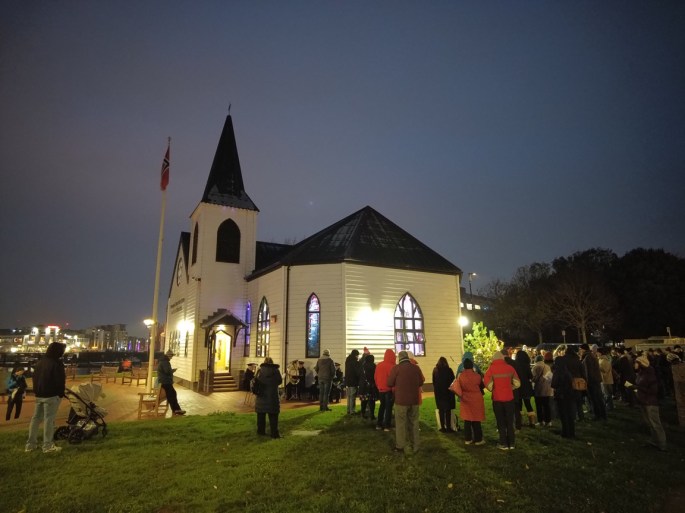
A religious service in Norwegian and English will be held in the Norwegian Church in Cardiff Bay this Christmas for the first time in decades. Rev Ingrid Ims of the Norwegian Seamen’s Mission in London will lead the service in a new addition to the Festival of Light of Friendship.
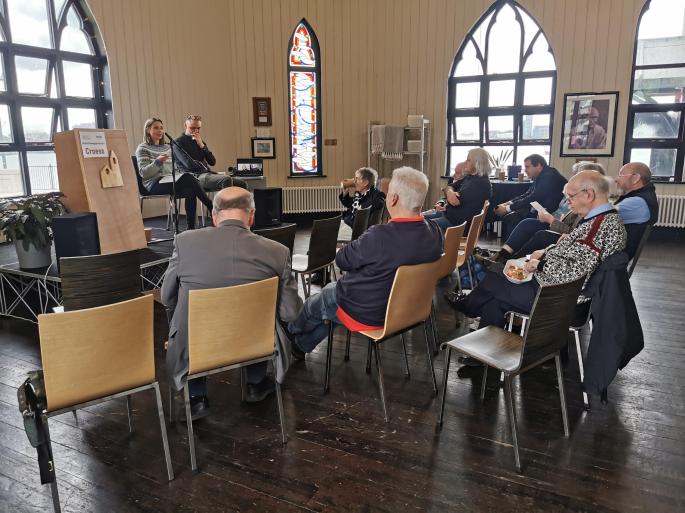
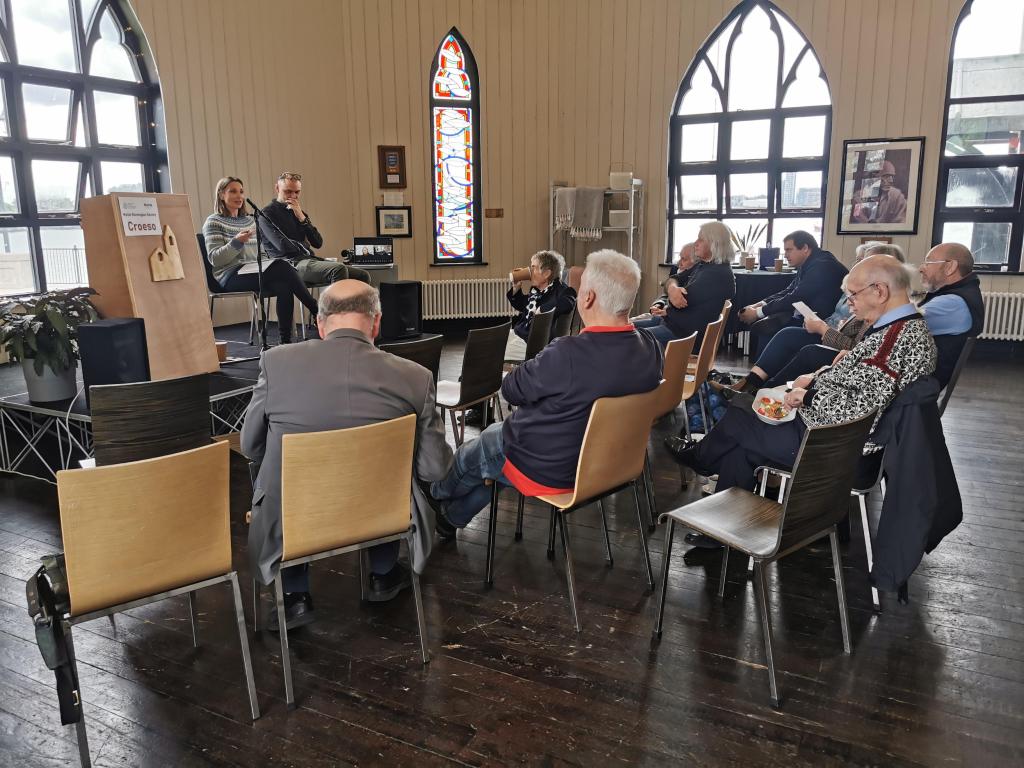
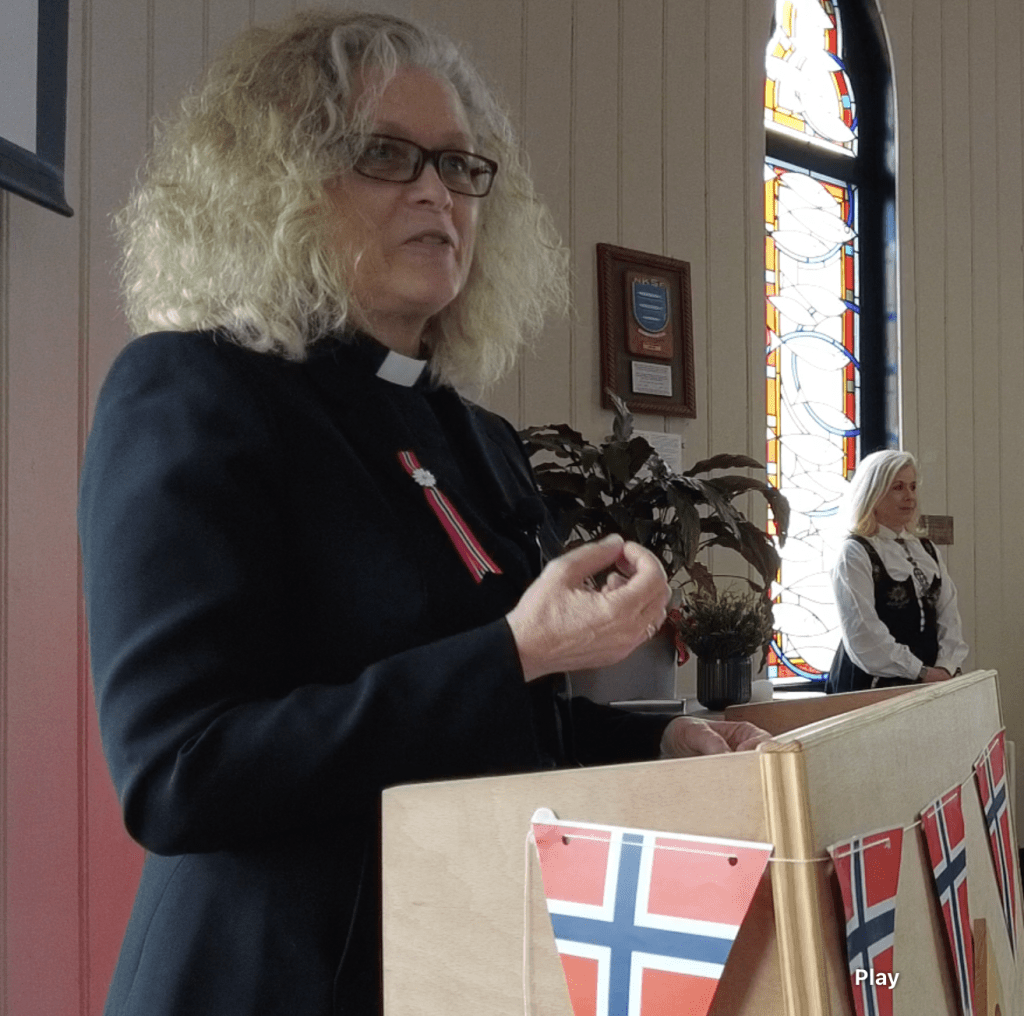
Ingrid Ims speaking at our Constitution Day event earlier this year. Rev Ims is based at the Norwegian Church Abroad (Sjømannskirken) where she is the pastor to Norwegian students in the UK.
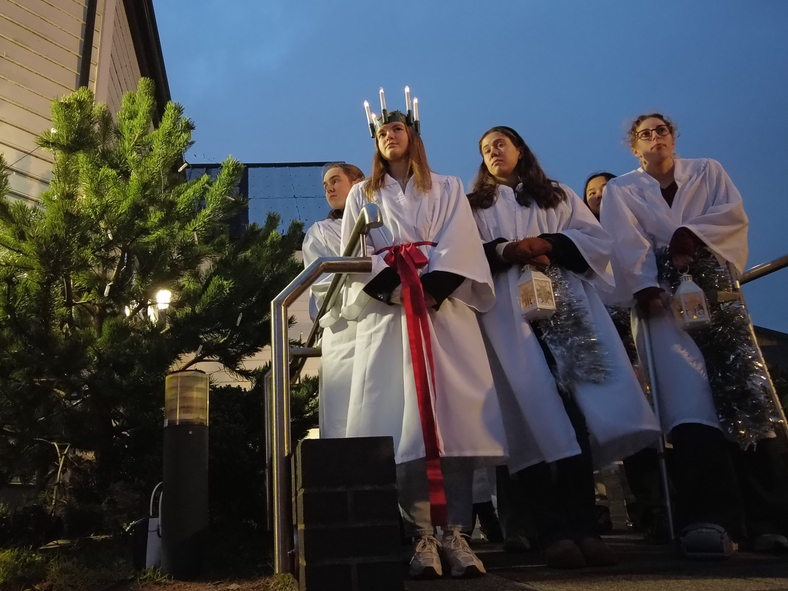
The Festival has become a popular event in the society’s calendar, and celebrates the friendships forged over generations between Wales and Norway. We welcome visitors from Norway, usually including representatives of Vestland Council in Bergen, with whom the society and the church have long-standing links. The Salvation Army band plays, carols are sung, and the Christmas trees inside and outside the church are lit. Traditional Norwegian Christmas food and drink including hot dogs, waffles, pepperkaker (like gingerbread) and gløgg (mulled wine) are consumed.
All are welcome.
Programme for the Festival of Light and Friendship Sunday 10 December 2023
3 pm – Christmas service, led by Revd Ims of the Norwegian Church Abroad
3.45 pm – Unveiling of the memorial plaque to Karen Allen, former member of WNS and manager of the Norwegian Church
4 pm – Salvation Army Band playing carols in the marquee
4.30 pm – Lighting of the Christmas trees
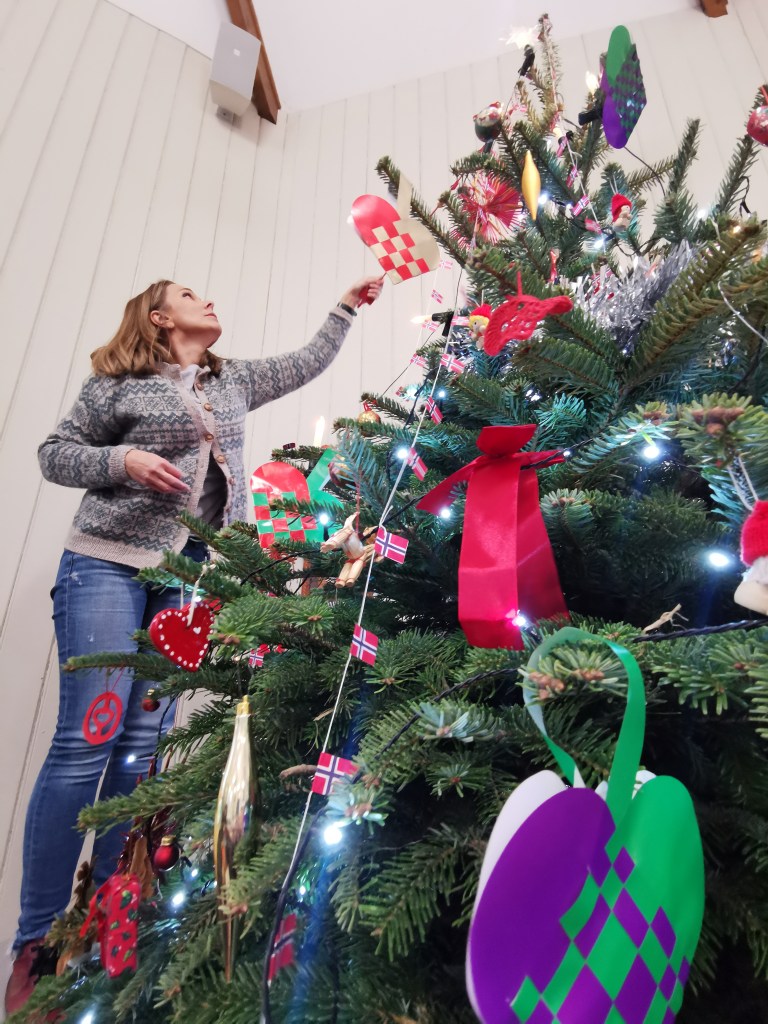
Please note that we will be decorating the indoor tree in typical Norwegian fashion at 2 pm on Sunday 26 November. Volunteers are again warmly welcomed!
The Annual General Meeting of the Welsh Norwegian Society was held at the Norwegian Church Arts Centre and Café in Cardiff on Sunday 24 September 2023. 18 members attended.
In the absence of an elected chair of the society, Torill Heavens took the chair for the meeting. She welcomed those attending and gave apologies from those unable to attend.
Minutes of the last AGM were circulated and agreed as accurate.
Committee members then reported on various areas of activity.
Membership – Johan Butenschøn Skre
Johan reported that there are currently 65 paid-up members. The number is fairly stable, albeit somewhat lower than during the days of active campaigning to return the church to community control.
There are 135 in a wider contact group who receive newsletters and other information.
Newsletters are read by 60 to 70 percent of those who receive them.
The society’s social activities and presence on social media are key to attracting to new members.
Finances – Kevin Burden
Kevin took over as treasurer mid-year. He described the difficulties experienced in trying to gain access to the bank account at Lloyds and the online account with PayPal. Part of this is because banks require several signatories from a membership body that is constantly changing. Many are making it more difficult for unincorporated societies (as WNS is) to maintain ‘treasurer’s accounts’ and some are actively closing such accounts. For this reason we have not attempted to move the account from Lloyds, as we had planned to do. However, Kevin has now been accepted as a signatory. We have access to online banking, which makes paying bills easier.
The Lloyds account holds £2,622, very close to the balance at the end of last year.
Despite submitting a request in January to authorise Kevin to access the PayPal (online bank) account, he had not been able to gain access by the time of the AGM. (However, following the meeting, Kevin and former account holders Thomas and Tyra managed to reset the authorisation protocol and regain control of the account. We confirmed that it holds £508.)
The society holds £111.50 in petty cash.
Kevin regretted that it had not been possible to present a full set of accounts in time for the meeting, due to the difficulties in gaining access to the bank accounts. These will be prepared as soon as possible and reported to the committee. The overall picture is, however, that receipts from subscriptions and ticket income from events is in line with spending on the events themselves and the cost of the Christmas tree.
Kevin told the meeting that using digital systems such as PayPal (used to manage subscriptions and one-off payments) and EventBrite (used to manage bookings for paid events such as the St Hans barbecue) significantly reduces the workload for committee members, albeit at a small cost, and makes communication with society members much easier. However the committee recognises the difficulty posed to members who do not use digital devices, and it was agreed that ways would always be found to accept cash or cheques where this is more convenient for members.
Tyra Oseng-Rees suggested the society should consider buying a contactless payment terminal, such as is used in the church café, which could accept payments at events. Kevin agreed to look into this.
Events – Anne Kirsti Rosnæs Kirby
Anne Kirsti recapped the social events that had been organised across the year, which have seen continually increasing attendances.
In December we held the Festival of Light and Friendship in grimly inclement weather conditions. The Lord Mayor of Cardiff attended, as did visitors from Vestland. The Salvation Army band played.
In January, Thomas Alexander Husøy-Ciaccia talked about the project he has led to collate the history and heritage of the church and the Norwegian community in Wales.
March: We had hoped to have a guest talk about learning Norwegian as a second language. Sadly, she had to withdraw due to illness but we nevertheless celebrated Norwegian waffle week with a variety of waffles made by Anne Kirsti, Torill and Tyra.
In April, members gathered for evening drinks before a concert in the church by James Kirby, half-Norwegian by virtue of being Anne Kirsti’s son!
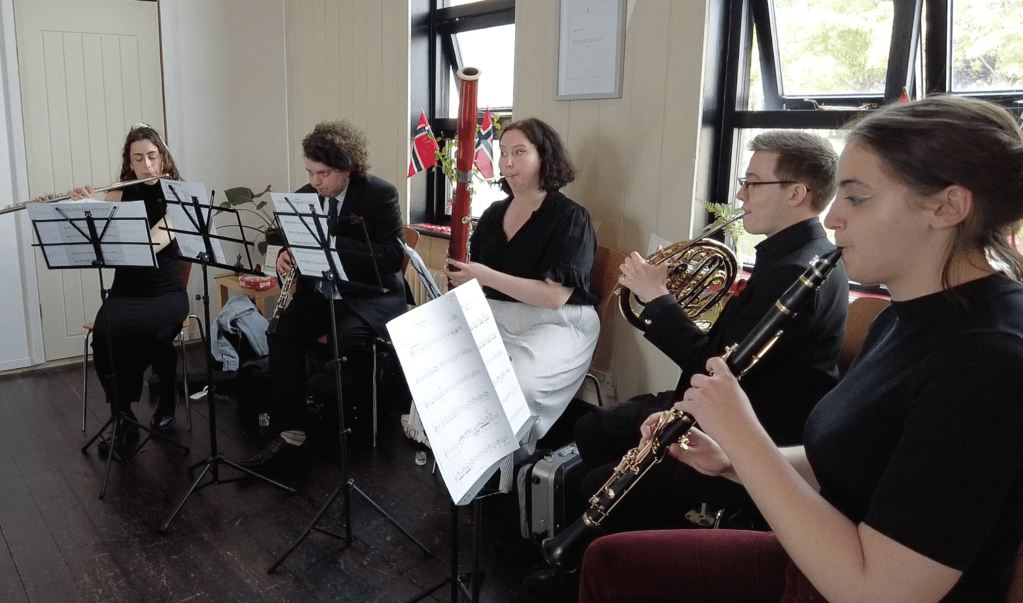
We marked Norwegian Constitution Day on 17 May in much finer weather than last year. Around 130 people processed from the Millennium Centre to the church, including visitors from Norway. The church’s resident Bute Wind Quintet played. Rev Ingrid Ims of the Norwegian Seamen’s Church in London gave a moving speech.
In June, we celebrated the Scandinavian midsummer festival of St Hans at a member’s house on the Gower with a barbecue, music, singing, a quiz and games. It was warm, dry and sunny, but the extended dry period meant we weren’t able to light a bonfire due to the risk of fire. We were pleased to welcome several new members.
The committee aimed to mount a similar programme for the coming year. Suggestions for other activities were always welcome. Running events does place demands on the organisers, and help – even if it is for a single event – is always appreciated.
Heritage – Thomas Alexander Husøy-Ciaccia
During the year, Thomas was appointed by the Norwegian Church Cardiff Bay charity as its heritage officer, with a specific mission to collate information about the history and heritage of the Norwegian communities in south Wales. He visited archives in Glamorgan and the home of the Norwegian Seamen’s Mission in Bergen. He found hundreds of documents, many written by hand in hard-to-read script, telling the story of the establishment of Norwegian churches in Cardiff, Barry, Swansea and Newport – and one in Milford Haven that never saw the light of day. The search uncovered lots of new material as few of the documents had been digitised and many were not even indexed.
Glamorgan Archives had retained some historical documents relating to the church, but were planning to discard some items. Thomas was able to retrieve some, including a piece of embroidery and a Norwegian pennant.
Thomas collated many artefacts for a temporary exhibition in the gallery at the Norwegian Church in Cardiff. It ran for several weeks from May and attracted interest from visitors who provided additional information. Thomas thanked members who had contributed information and loaned items for display.
Much of the content of the exhibition has been loaded onto a touch screen display in the church. It is also accessible online.
His historical research revealed a large number of photographic negatives, but the people in them were unidentified. It was suggested that perhaps the pictures could be displayed at a society meeting or online and people invited to name those they recognised.
Throughout the year, Thomas met a number of individuals and held outreach days for members of local history societies.
Thomas is now coming to the end of his one-year contract. The trustees have submitted an application for further funding from the National Lottery.
Communications – Kevin Burden
Over the new year Kevin moved the society website and its contents to a new host which is both cheaper and easier to manage. He has been reorganising the historical content to make it easier to find, adding other material such as past newsletters and media reports, and adding new content: 14 articles so far this year.
The new site has been visited 1100 times since it was set up. Most of the visitors come from the UK, with smaller numbers from the US and Norway. Most people find the site through search engines such as Google, but other visitors come from Facebook and via press reports such as the article in the Nation. The most popular pages have been the home page, which explains what WNS does; the archives; and the programme for 17th May celebrations this year.
Despite its loss of popularity with younger people, our Facebookpage remains active, mostly as a way of disseminating news quickly and publishing pictures and videos of our social events. It has 762 followers, split evenly between men and women. 60% are in the UK, almost all of them in South Wales. 12% are in Norway and 17% in the US and Canada! Posts typically reach 300-400 people, peaking around the major calendar events. We post more or less as often as other small societies, but our posts generate fewer responses. Attempts to generate discussion about learning the language, travel to Norway, or other talking points have not been successful – apart from a post about the cost of a gent’s haircut! Kevin filmed and uploaded videos from our social events such as the lighting of the Christmas tree, the 17th May procession, and the Salvation Army Band playing Norwegian tunes; but these have not proved popular: perhaps the audience who would appreciate them most are not finding them?
We have a Twitter/X account which has 364 followers. However, since the summer we have not been able to post updates as Mr Musk has introduced a subscription fee of £140 in order to access the software we use to create and schedule posts. It was agreed that we would stop activity on the platform.
The society has a YouTube channel with a handful of older videos. A video interview that Kevin carried out with Thomas about the history of Norwegians in Wales (and which was featured in a news article in the Nation) has been watched 200 times.
We aim to send out newsletters 8-10 times a year by email, and these are clearly an important source of information to those who are not active on social media. We are no longer sending printed newsletters, due to the cost and effort in producing, printing and posting them.
Relationship with the Norwegian Church Cardiff Bay – Mike Parkinson
As well as being a member of the society, Mike is a trustee of the Norwegian Church Cardiff Bay (NCCB), the new charity set up to manage the church on a long lease from Cardiff Council. Mike recalled that the trustees had been handed the keys to the building only 18 months ago. The building was empty, the kitchen was not in a functional state, and other equipment was missing. The trustees found start-up capital from three charitable foundations which enabled them to recruit a general manager (Gareth Jones) and re-open the building to the public.
The initial aim was just to survive the very difficult trading conditions being experienced by all arts and hospitality venues post-pandemic. In fact, Gareth had been able to put on public music and comedy events once or twice weekly, and attract bookings to use the venue for weddings and private parties, corporate training and awaydays, Senedd meetings, exhibitions and even filming for TV. These events have helped the church to more than break even during its first year of independent operation. Over the Christmas period, a marquee will again be sited on the outdoor terrace, and will be offered for private parties.
However, the Norsk café operated at a loss. An external catering company was therefore invited to take over its running. The company now runs the kitchen, providing food both for the café and for home delivery services. A profit-sharing arrangement ensures money flows to the Norwegian Church. At the moment the menu is based around burgers, fries and innovative takes on Yorkshire puddings, and this has proved very popular. The caterers plan to introduce more Scandinavian-themed items as they settle in and understand customer demand. Torill suggested they look at the example of the Norwegian café in Harrogate, which offers a Norwegian version of bubble and squeak with sausages.
Now that the church is on a more secure footing, the trustees hope to increase the number of public events reflecting Norwegian and Scandinavian culture. Further funding is being sought from the National Lottery Heritage Fund which would secure the position of heritage officer and enable an education officer to be recruited. A decision is expected soon.
Martin Price informed the meeting that the church building was given Grade 2 listed status in March, even though the building has moved from its original site and been substantially altered. (Purists might take the view that the building really dates from 1991.) This means that Cardiff Council will have to preserve and maintain it.
On behalf of the society, Torill thanked the trustees and staff for all that they had achieved over the first 18 months of operation.
Anne Kirsti asked that the society be allowed to hang a promotional poster in the church so that visitors could learn of its existence.
Future events
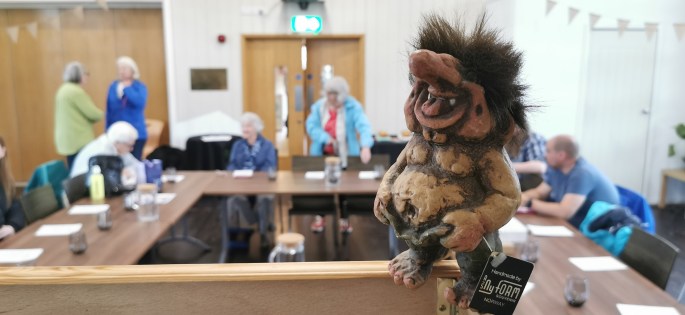
On 21 October Thomas will give a presentation in the gallery on trolls. Those with troll models at home are invited to bring them.
On 26 November we will gather to decorate the Christmas tree inside. There will also be two new live trees outside, to replace the large tree which has died.
We will hold the Festival of Light and Friendship on 10 December. In the afternoon, Ingrid Ims from the Seamen’s Mission in London will lead a bilingual service in the church for the first time in a generation. Members with an interest in the arrangements agreed to meet soon to make plans.
We will take a break in January. There was a suggestion to hold a session on learning Norwegian, which might be suitable for February. Tyra mentioned that she has a collection of books in Norwegian. Unfortunately there is no space in the church to create a library but perhaps members would like to consider a book exchange.
Election of new committee
WNS committee members and trustees of the Norwegian Church Cardiff Bay during the society’s 2023 AGM. From left, Martin Price (NCCB), Shuna Lovering (WNS), Craig Williams (WNS), Johan Butenschøn Skre (WNS), Torill Heavens (WNS), Alex McDonald (WNS), Mike Parkinson (NCCB), Bethan White (WNS), Kevin Burden (WNS).
Nick Webb resigned from the committee during the year as he moved away from Wales. Anne Kirsti Rosnæs Kirby and Thomas Husøy-Ciaccia said they would not be standing for re-election, though remained willing to help with events.
Torill Heavens, Craig Williams and Kevin Burden volunteered to serve another year on the committee and were duly re-elected.
Bethan Winter, Shuna Lovering and Alex McDonald volunteered to join the committee and were elected unanimously.
The new committee will be invited to review the nominations that have been received for honorary membership.
Remembering Karen Allen
At the suggestion of the church trustees, the committee has asked our past chair, Tyra Oseng-Rees, a glass artist, to create a plaque to hang in the church to remember Karen Allen, the former manager of the church arts centre when it was in council control and a leading member of the society. Wording has been agreed in English, Welsh and Norwegian. Tyra brought some samples of the recycled glass tiles she makes for members to indicate their preferences.
Any other business
Mike Parkinson noted that the new intake of eight Norwegian students has arrived at Cardiff and the Vale College. They will be staying in halls rather than with families as in previous years. He proposed that the society might like to welcome them and make themselves available to them. His suggestion was warmly agreed.
All business having been completed, the meeting closed at 16:30.
All are welcome to join us at the Norwegian Church in Cardiff for a social event, but also a chance for all to shape the running of your society. 17th May, St Hans, and the Festival of Light and Friendship are, of course, highlights of the calendar, but what else should we be doing? Are there events you think we should be holding in the church in Cardiff, such as film nights, language lessons, cooking classes or other craft or cultural events? Should we get out and about more, and meet outside the capital from time to time? Many of our members live in the Swansea area. We already hold our St Hans bonfire and barbecue on the Gower, but should we do more in the area? Should we visit the Norwegian-run cafe in Abergavenny for coffee and cake?
Do join us at the AGM to discuss the possibilities. Even better, volunteer your skills to make them happen! We welcome support, whether it is to support the running of a single event or to help keep the society ticking over year-round. We’ll elect a new committee; volunteers and nominations are welcome.
We’d like to identify members who’ve made a special contribution to the running of the society over several years and make them honorary members. Please feel free to make nominations via email to contact@welshnorwegian.org.
This year we will also remember Karen Allen, a loyal friend of the society and the Norwegian church, who sadly died last year. We’ve a painting of the church to unveil and we’ve plans to put up a plaque to celebrate her life and invaluable contributions to the church and the society.
We’ll write more about our plans shortly, but we wanted to give you as much notice as possible of the dates we’ve agreed for our autumn programme of events.
Sunday 24 September, 2.30-4.30 pm: A.G.M.
We’ll elect a new committee (volunteers and nominations welcome!), discuss ideas for events and social gatherings, and remember Karen Allen, a loyal friend of the society and the Norwegian church, who sadly died last year. We’ve a painting of the church to unveil and a plaque to celebrate her life.
Saturday 21 October, 2 pm – Trolls!
Thomas Alexander Husøy-Ciaccia will host our celebration of Norway’s mountain-dwellers, the trolls.
Sunday 26 November, 2 pm – Decorating the Christmas tree
We’ll make and hang decorations on the tree in Norwegian style. Special fun for families!
Sunday 10 December – Festival of Light and Friendship
This much-loved annual event where we light the Christmas trees indoors and out. We are also hoping to be able to hold a bilingual service in the church for the first time in decades. More details to follow.
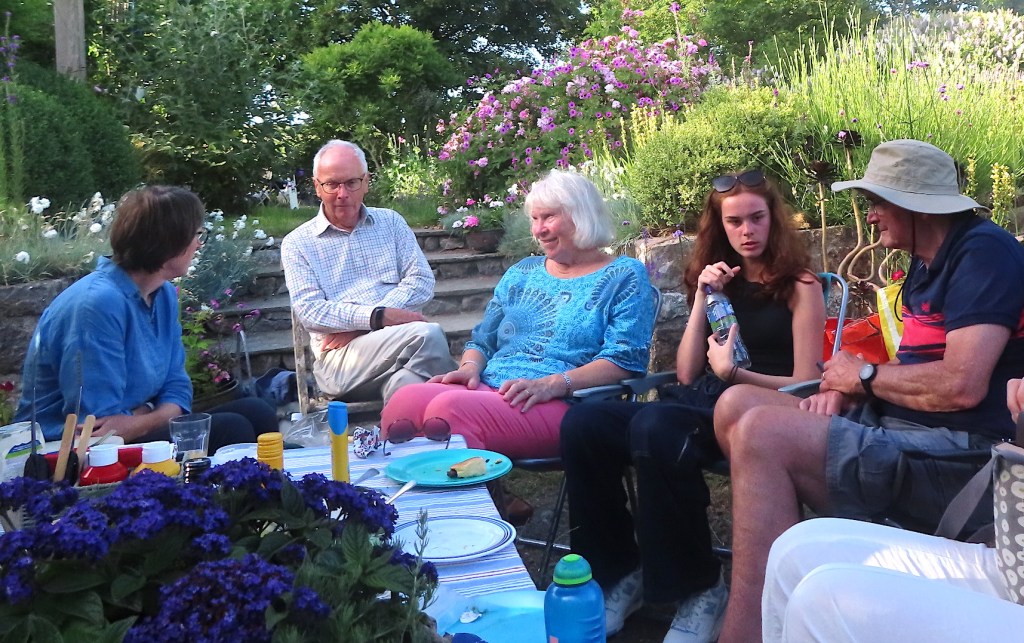
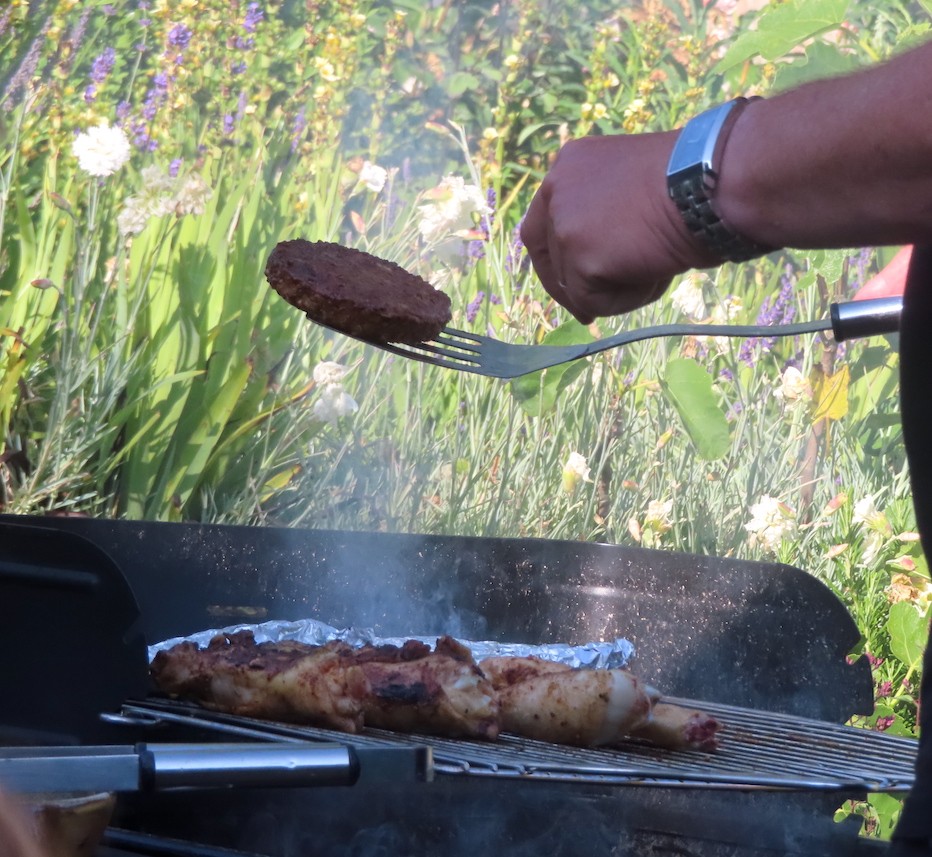
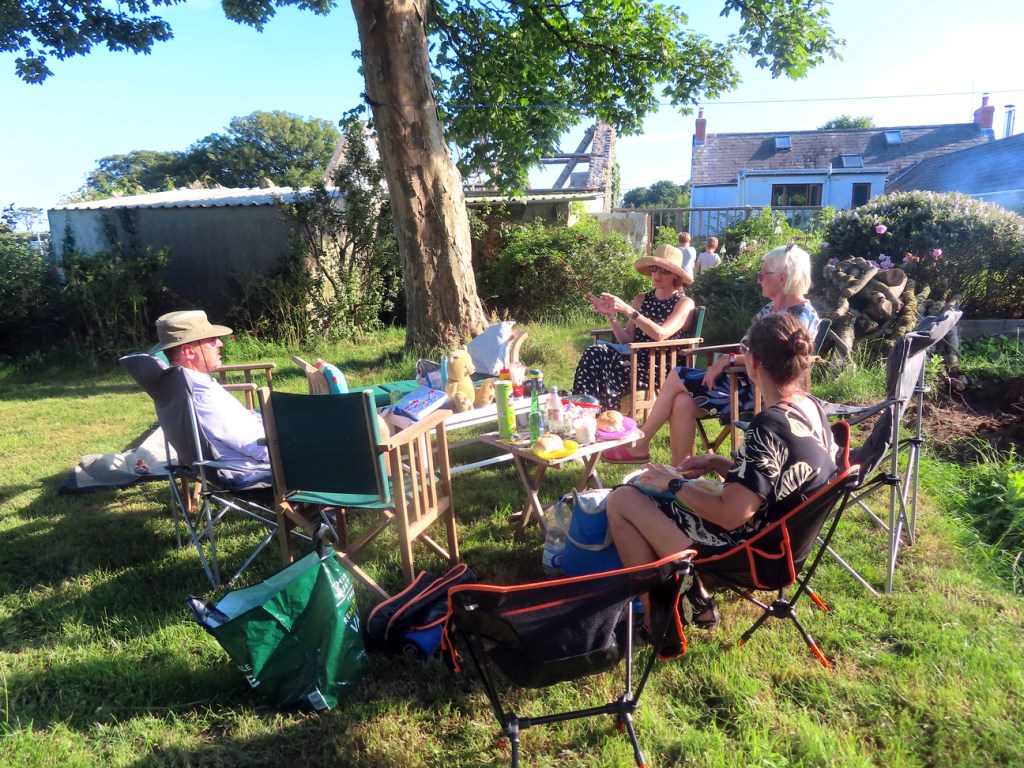
Thirty members gathered in the Gower for the society’s annual St Hans celebration of midsummer. After four weeks without rain leading to tinder-dry ground conditions (and in contrast to last summer’s washout), it was too risky to light a bonfire, but we were able to fire up the barbeques and enjoy food and fine company al fresco. Janet Neilson’s lovely pictures also show the indoor entertainment kindly led by Torill. Many thanks to her and Anne Kirsti for organising everything and to Sol and her family for so kindly hosting.
It was wonderful to see so many of you at the 17th May events in Cardiff last week. It feels like we are slowly but surely returning to a kind of normality. Now our second big event of the year is almost upon us – the St Hans Midsummer barbecue and party in the Gower on Saturday 24th June between 5 and 10.30 pm.
Please save the date – and get your tickets as soon as possible, as places are limited. Early booking also really helps our hosts and small team of volunteers get things ready.
The occasion
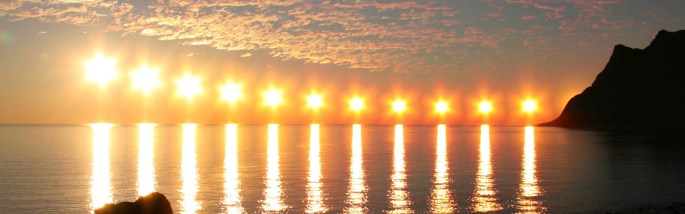
Norway is, of course, the Land of the Midnight Sun, and along with the rest of Scandinavia, throws a big party on or around the summer solstice, typically 21st June. In Norway the celebrations are named after ‘St Hans’, who is known in English as John the Baptist, and usually held on the evening of 23rd June, St Hans’ Eve, with bonfires (often on the beach), eating, drinking, and making music.
There is a religious dimension to the festival, but it is also a celebration of summer, the solstice, the turning of the year, the forthcoming harvest – and fertility. It is also the Night of the Witches – so bonfires are lit to drive them away. A typical mishmash of elements of Christian, pre-Christian, and modern traditions.
Our venue
Our venue is a private garden in south-west Gower, kindly made available for our use by a member. The address and directions will be shared with members after booking. Please park carefully outside the venue to allow others freedom to leave at any point.
What to bring
Please bring your food and all crockery and cutlery for your personal use, including cups or mugs for drinks.
We welcome you to bring music instruments if you play any.
We will arrange for barbeques, provide wood for the bonfire and charcoal for the barbeques, and tea, coffee, squash and home-made cakes.
Accommodation
There is space on the grounds for three tents to pitch. Please reserve a space when booking. There is an outside toilet, but no shower facilities. There are of course many other accommodation options on the Gower.
Weather
We all hope for and expect good weather in late June – but this is Wales! We had to postpone last year’s event because of heavy rain. If we are again hit by bad weather, we will let you know as soon as we can, and postpone our party until the following weekend.
Booking
Tickets cost £7 per adult and £4 per child, which goes to cover the cost of wood and charcoal, refreshments, and liability insurance cover for the private home.
There is no additional charge to camp, but please reserve a space when you book.
This is a members-only event, so please ensure at least one of your party is a paid-up member of WNS. You can take out or renew membership (£10/year) on the booking form.
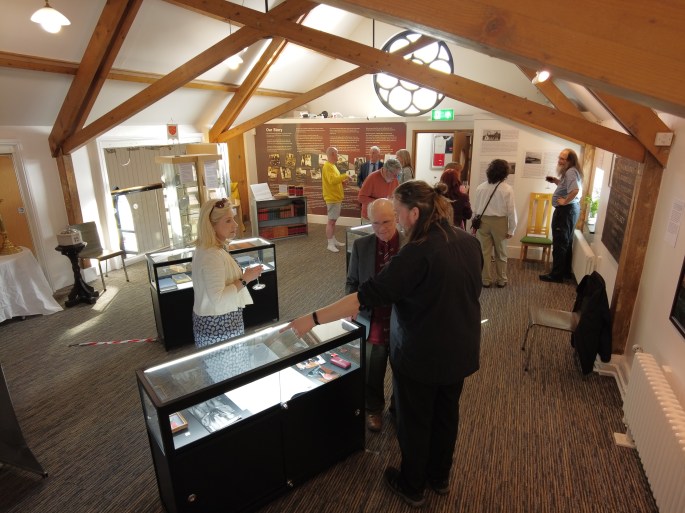
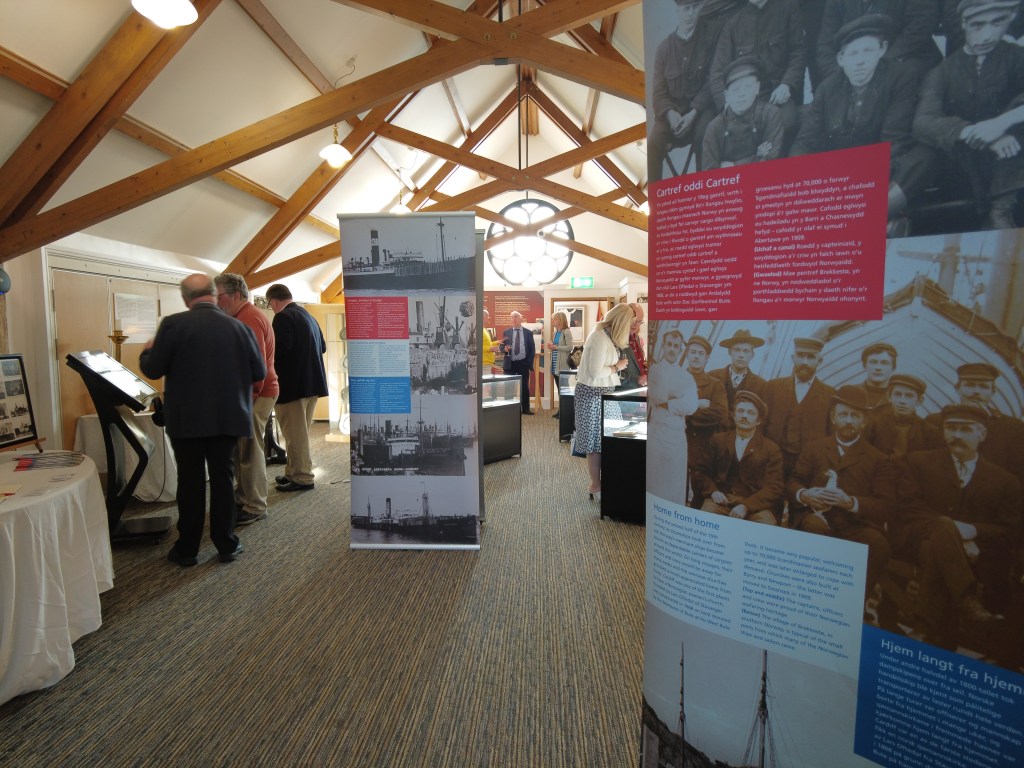
A new exhibition in Cardiff is telling the story of the Norwegians who came to south Wales in the mid 1800s as seamen and merchants servicing the coal trade. It opened on Norwegian National Day, 17th May, and will run until the end of June 2023. For opening hours, please check the website of the Norwegian Church Arts Centre at https://www.norwegianchurchcardiff.com/
The new exhibition upstairs at the Norwegian Church in Cardiff
At one point there were so many Norwegians in South Wales that the Norwegian Seamen’s Mission established four churches – in Cardiff, Swansea, Barry and Newport – to serve not only as places of worship, but also as community centres, libraries, and providers of welfare and communication for people far from home.
As the coal trade declined, and congregations became more integrated into Welsh society, the churches closed. However, the buildings in Cardiff and Swansea were preserved, albeit on new sites, and now the Cardiff church is the home of a thriving arts and cultural centre and café.
Thanks to a National Lottery Heritage Fund grant and with the support of the Norwegian Seamen’s Mission in Bergen, heritage officer Thomas Alexander Husøy-Ciaccia has been tracing the story of the churches in south Wales and their communities, and has curated the new exhibition at the Norwegian church in Cardiff Bay.
In a new video Thomas tells Kevin Burden of the Welsh Norwegian Society about the churches’ place in the rapid changes in Wales in the 19th and 20th centuries.
Heritage Officer Thomas Husøy-Ciaccia explains the story of Norwegians in south Wales
2023 saw one of the largest celebrations of Norway’s Constitution Day in Cardiff for some years. Post-pandemic, and blessed with fine weather, almost 200 people turned up to join the celebrations, starting with a procession from the Wales Millennium Centre via the Senedd to the Norwegian Church on the bayside.
Martin Price, trustee of the Norwegian Church Cardiff Bay charity, welcomed the procession.
The flag was hoisted over Cardiff Bay after the singing of the National Anthem, Ja vi elsker, accompanied by the band of the Salvation Army.
Torill Heavens, a committee member of the Welsh Norwegian Society, welcomed everybody and led proceedings in the hall. Torill is also a member of the Salvation Army Band that played for us throughout the afternoon.
Cato Syversen, the CEO of the Cardiff-based Norwegian company Creditsafe, and a trustee of the Norwegian Church Cardiff Bay, gave the traditional 17th May speech, explaining the date’s significance to Norway and Norwegians.
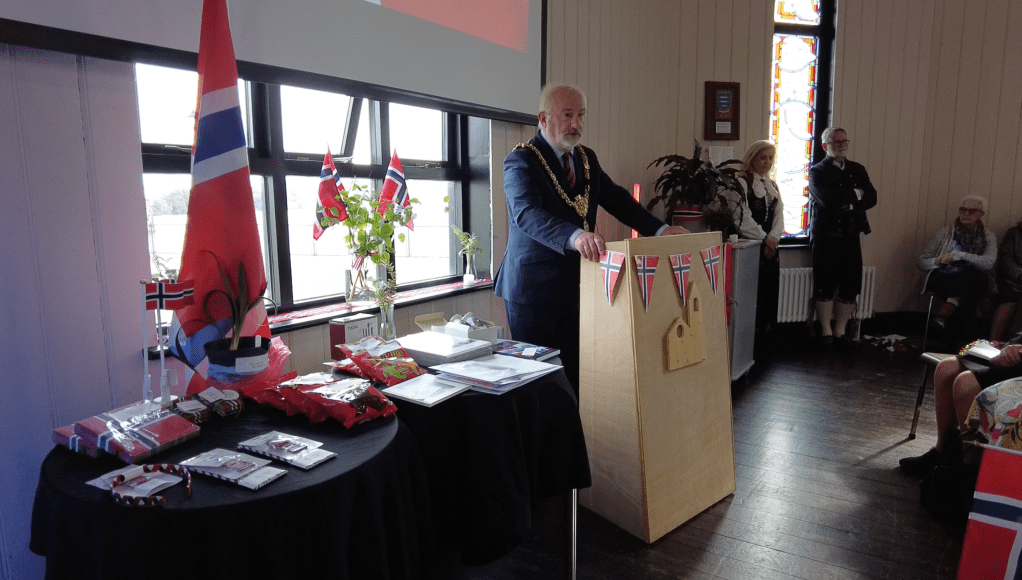
The Lord Mayor of Cardiff, Councillor Graham Hinchey, wished everyone “gratulerer med dagen“. The city council looked after church after it closed for services until last year, when it was handed over to a new charity, the Norwegian Church Cardiff Bay.
Nine-year-old Eira Oseng-Rees is a typical member of our community. With a Welsh father and Norwegian mother, she has grown up bilingually in south Wales – which she demonstrated by reading the poem “17. mai er jeg så glad i” – “I love 17th May so much” in both Norwegian and English.
The Church in Norway continues to support Norwegians living, working and studying abroad, even if it has far fewer physical places of worship than in the peak days of Norway’s merchant navy.
Ingrid Ims is a chaplain based at the Norwegian Church in London who works with communities throughout the UK and Ireland. She is especially keen to reach out to Norwegian students in Wales.
Ingrid expanded on Cato’s thoughts about the meaning of 17th May and its place in Norwegian independence.
Remembering the losses that Norway had suffered during its occupation during World War Two, she laid a wreath in the church to remember the fallen.
“Vi lyser fred over deres minne,” she said: We shine peace upon their memory.
The Welsh have St David’s Day, the Irish St Patrick’s Day. And the Norwegians? Well, we have syttende mai, 17th May, when we commemorate the signing of our constitution in 1814. Norway had been ruled by Denmark for four centuries, but had just suffered a devastating defeat in the Napoleonic Wars and was to be transferred from Denmark to Sweden as a penalty. The constitution declared Norway an independent kingdom – a goal that was not reached until 1905, when the union was Sweden was finally dissolved.
17th May is huge. Whilst many countries celebrate their national day with a military parade, Norway holds a party for everyone, especially children, with marching bands, parades, national costumes and ice cream. Lots of ice cream. Before they head out onto the streets, many people will have a “17th May breakfast” – often a bring-a-dish party with friends and neighbours – with freshly-baked bread, scrambled eggs, smoked salmon and champagne.
Children then parade through the streets, led by marching bands, waving flags and shouting “hurra!”. The largest parades attract tens of thousands of people. In Oslo, the procession is greeted by the royal family.
Ice cream and hot dogs are eaten while games are played. Speeches are made during the afternoon. The festivities are often rounded off in the evening with a special meal with friends and family.
Inevitably, our celebrations in Wales, taking place hundreds of miles from Norway, are somewhat muted, but we try to include as many of the familiar elements as we can – from the parade to the party food, the music to the speeches.
Thank you for joining us to celebrate 17th May this year!
Programme for the Day
16.45 Procession sets out from the Wales Millennium Centre, Roald Dahls Plass, Cardiff
17.00 Gathering at the Norwegian Church to raise the flag and sing the Norwegian national anthem
Welcome by Martin Price, Chair, Norwegian Church Cardiff Bay
17.15 Move inside the church for a traditional 17th May programme led by Torill Heavens
Addresses from Cato Syversen, CEO, Creditsafe; Councillor Graham Hinchey, the Rt Hon the Lord Mayor of Cardiff; and a representative of Vestland County, Norway
Poem read by Eira Oseng-Rees
Wreath laid by Ingrid Ims from the Norwegian Church in London.
17:45 End of official programme. The café will remain open for the sale of refreshments and Norwegian food items
We would like to thank the Salvation Army Band for making our celebration a true Norwegian experience by learning our national anthem and joining us come rain or shine.
Ja, vi elsker
The Norwegian National Anthem
Words by Bjørnstjerne Bjørnson
Ja, vi elsker dette landet Som det stiger frem Furet, værbitt over vannet, Med de tusen hjem Elsker, elsker det og tenker På vår far og mor Og den saga natt som senker drømme på vår jord
Yes, we love with fond devotion This our land that looms Rugged, storm-scarred o’er the ocean With her thousand homes. Love her, in our love recalling Those who gave us birth. And old tales which night, in falling, Brings as dreams to earth.
Norske mann i hus og hytte, Takk din store gud. Landet ville han beskytte, Skjønt det mørkt så ut. Alt hva fedrene har kjempet Mødrene har grett Har den herre stille lempet Så vi vant, vi vant vår rett
Norseman, whatsoe’er thy station, Thank thy God whose power willed and wrought the land’s salvation In her darkest hour. All our mothers sought with weeping And our sires in fight, God has fashioned in His keeping Till we gained our right.
Ja, vi elsker dette landet Som det stiger frem Furet værbitt over vannet Med de tusen hjem Og som fedres kamp har hevet Det av nød til seir Også vi, når det blir krevet For dets fred slår leir Også vi når det blir krevet For dets fred, dets fred slår leir
Yes, we love with fond devotion This our land that looms Rugged, storm-scarred o’er the ocean With her thousand homes. And, as warrior sires have made her Wealth and fame increase, At the call we too will aid her Armed to guard her peace.
17 mai er jeg så glad i
By Margrethe Munthe
17. mai er vi så glad i, moro vi har fra morgen til kveld! Da er det så du, om vi er små du, er vi med likevel. Jeg roper hurra dagen så lang, synger for Norge mangen en sang Og jeg, jeg kan duelske mitt land du, det skal du se en gang
We love 17 May, We have fun from morning to night! That’s how it is, We take part Even if we are small. I shout hurray all day long, sing many a song for Norway And I, I can love my country You, you have to see it once
Norge i rødt, hvitt og blått
‘Norway in red, white and blue’
Words by Finn Bø, Bias Bernhoft og Arild Feldborg
Hvorhen du går i li og fjell, en vinterdag, en sommerkveld med fjord og fossevell, fra eng og mo med furutrær
Fra havets bryn med fiskevær og til de hvite skjær, møter du landet i trefarvet drakt, svøpt i et gjenskinn av flaggets farveprakt. Se, en hvitstammet bjerk oppi heien, rammer stripen med blåklokker inn mot den rødmalte stuen ved veien, det er flagget som vaier i vind. Ja, så hvit som det hvite er sneen, og det røde har kveldssolen fått, og det blå ga sin farve til breen, det er Norge i rødt, hvitt og blått.
Where’er you go in fields or hills A winter day, a summer eve By fjord and waterfalls From meadows and heaths with pines
From oceans shore with fishing grounds And to the white-washed reefs You meet the country in tricolour
Wrapped in reflection of the flag’s coloured glow. See the white-stemmed birch on the hillside Framing in the bluebells with ribbons. Put beside the red-painted cottage by the roadside, It’s the flag that waves in the breeze.
Yes, as white as the whiteness of snow And the red has the sunset been given And the blue gave its colour to the glacier. That is Norway in Red, White and Blue.