Our next social gathering on Sunday 26 February will be especially suitable for families. We’ll be marking fastelavn – “the Nordic tradition you’ve probably never heard of,” according to one blogger – with two traditions that are typical of northern Europe, but almost unknown here.
Fastelavn is the eve of lent, and is a Protestant festival celebrated across northern Europe, including Scandinavia, Finland, Estonia and Germany. Scots know it as Fastens-een. It’s related to carnivals marked at this time of year in Catholic countries, and Shrove Tuesday – pancake day – in the UK. Strangely, it is celebrated on different days in the Scandinavian nations: this year it will be celebrated in Norway on 19 February.
The festival is celebrated differently between the countries and even between regions. We will be adopting two practices this year: eating fastelavnsboller and making Shrovetide rods or sticks – with which children are supposed to beat their parents to wake them on Fastelavns Sunday, though we will not necessarily be following this custom!
Fastelavnsboller are Shrovetide buns – sweet rolls with a filling, typically cream, jam or stewed fruit, and usually iced. There has been lively debate among members of the Welsh Norwegian Society about the right combination of filling and icing – this is very much comes down to family and local custom. There’s a Norwegian recipe here.
The Shrovetide rods are birch twigs decorated with feathers, or sometimes strips of paper, sweets, figurines and even eggshells. Apparently, particularly pious people used to lightly flog their children on Good Friday to remind them of the sufferings of Christ on the cross. In return, children won the right to flog their parents on Fastelavns Sunday – and were rewarded with a sweet bun. Today, children in Denmark sing a special song to demand their reward:
Shrovetide is my name,
buns I want.
If I get no buns,
then I make trouble.
Buns up, buns down
buns in my tummy.
If I get no buns,
then I make trouble.
Come and join us at the Norwegian Church in Cardiff on Sunday 26 February from 2.30 pm for buns, Shrovetide rod-making, fun, company and chatter.
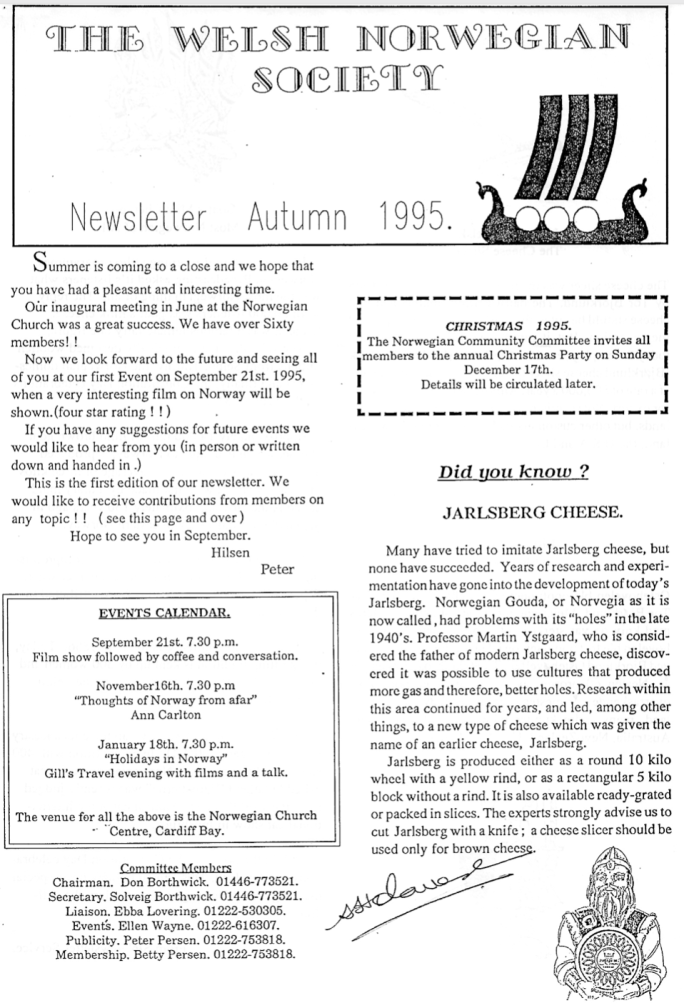
Summer is coming to a close and we hope that you have had a pleasant and interesting time.
Our inaugural meeting in June at the Norwegian Church was a great success. We have over sixty members! !
Now we look forward to the future and seeing all of you at our first event on September 21st, 1995, when a very interesting film on Norway will be shown (four star rating!!)
If you have any suggestions for future events we would like to hear from you (in person or written down and handed in .)
This is the first edition of our newsletter. We would like to receive contributions from members on any topic !! (see this page and over)
Hope to see you in September. Hilsen Peter
EVENTS CALENDAR
September 21st. 7.30 p.m. Film show followed by coffee and conversation.
November 16th. 7.30 p.m ‘Thoughts of Norway from afar’ Ann Carlton
January 18th. 7.30 p.m. ‘Holidays in Norway’ Gill’s Travel evening with films and a talk.
The venue for all the above is the Norwegian Church Centre, Cardiff Bay.
Committee Members
Chairman. Don Borthwick [telephone number redacted] Secretary. Solveig Borthwick [telephone number redacted] Liaison. Ebba Lovering [telephone number redacted] Events. Ellen Wayne [telephone number redacted] Publicity. Peter Persen [telephone number redacted] Membership. Betty Persen [telephone number redacted]
CHRISTMAS 1995 The Norwegian Community Committee invites all members to the annual Christmas Party on Sunday December 17th. Details will be circulated later.
Did you know ?
JARLSBERG CHEESE.
Many have tried to imitate Jarlsberg cheese, but none have succeeded. Years of research and experimentation have gone into the development of today’s Jarlsberg. Norwegian Gouda, or Norvegia as it is now called , had problems with its holes in the late 1940’s. Professor Martin Ystgaard, who is considered the father of modern Jarlsberg cheese, discovered it was possible to use cultures that produced more gas and therefore, better holes. Research within this area continued for years, and led, among other things, to a new type of cheese which was given the name of an earlier cheese, Jarlsberg.
Jarlsberg is produced either as a round 10 kilo wheel with a yellow rind, or as a rectangular 5 kilo block without arind. It is also available ready-grated or packed in slices. The experts strongly advise us to cut Jarlsberg with a knife; a cheese slicer should be used only for brown cheese.
Litt på engelsk The Cheese Slicer
The cheese slicer was invented in Lillehammer in 1925 by Tor Bjørklund. The dairies firmly maintained that cheese should be cut with a knife, and strongly opposed the invention. But it rapidly gained popularity, and today the employees of the Bjørklund Ostehøvelfabrikk (Bjørklund Cheese Slicer Factory), are turning out slicers at a rate of 800,000 a year. Almost 60 percent of these go for export. Not surprisingly the bulk goes to the Netherlands, but other customers include Australia, New Zealand, the U.S.A. and Lebanon.
Litt på norsk Ostehøvelen
Ostehøvelen ble oppfunnet på Lillehammer i 1925 av Tor Bjørklund. Meieriene mente at ost skulle skjæres med kniv og var sterkt imot oppfinnelsen. Men ostehøvelen ble fort populær, og i dag produserer de ansatte ved Bjorklund Ostehøvelfabrikk 800,000 ostehøvler per år. Nesten 60 prosent av dette gar til eksport. Ikke overraskende går mesteparten av ostehøvlene til Holland, mens andre kunder inkluderer slike land som Australia, New Zealand, U.S.A og Lebanon.
Goat’s Milk Cheese, Most Norwegian of All
In a series of mid-morning radio programmes, Norwegian Broadcasting asked its listeners what was the most Norwegian thing of all. The reply from 30,000 listeners was goat’s milk cheese. Second, was a famous female fairy tale figure, followed by the characteristically designed woollen mittens from Selbu. Thirdly, the Norwegian domestic cat and finally, the Constitution Day celebrations on the 17th. of May
Approximately 14,000 tons of mild brown goat cheese, which is unique to Norway, is produced annually. Norwegians cat an average of three kilos of it each year. It was first made by a diary maid called Anne Hov approximately 130 years ago in the Gudbrandsdal valley in eastern Norway.
The old lady in the fairy tale is the uncompromising woman who sticks to her guns no matter what. A positive attitude and dynamism are attributed to this woman.
The first Selbu mitten was made in 1856. Today, this knitting tradition is kept up by 300 women and one man who deliver their products to the Selbu Cottage Industry company.
The Norwegian domestic cat can trace its ancestry back to the year 1500 A.D. In competition with 400 cats from 20 countries, a Norwegian domestic cat called ‘Flatland Bjørnstjerne’ was recently judged to be the world’s most beautiful cat at the international cat show in Innsbruck.
Fifth in the poll was the Constitution Day celebrations on May 17th. This annual holiday has a special meaning for all Norwegians, particularly the children.



 Welsh Norwegian Society