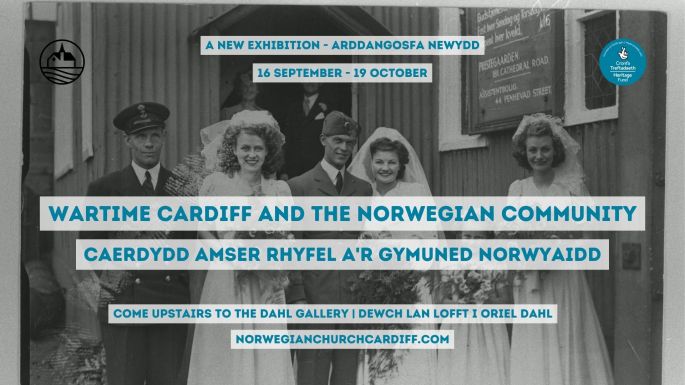
During the Second World War, Cardiff became a temporary home for many Norwegians — seafarers, refugees, and members of the resistance — who helped shape the city’s wartime history.
Now, a new exhibition aims to tell their story. It’s being organised by the heritage officer at the Norwegian Church in Cardiff Bay, Thomas Husøy, and his colleagues. They would love to hear stories of the Norwegian community from that time, and would especially welcome the chance to put on display photographs, artefacts, and archival material.
Editor's note: Ken wrote this charming recollection of his involvement with the Welsh Norwegian Society for our Autumn 2021 magazine. We re-publish it now following his passing as the best possible testimony for his contribution to the preservation of the church, to the society and the community over many, many years. Ken's wife Signe pre-deceased him shortly after he wrote this account.
It is lovely to have the opportunity to share few of my recollections of becoming involved with the Norwegian Welsh Society. Over the years it has brought me into contact with many wonderful people. Some are named below, and I apologise to those missed out.
My involvement came about because of an earlier association with norskkrigseilerssamfunnet which enabled Norwegian seafarers who had sailed with the Allies during the Second World War to maintain contact with each other. During the early eighties, [my Norwegian-born wife] Signe and I were honoured to be allowed access to this formidable association of Norwegians who had sailed on the famous one thousand ships that defied the Quisling Government’s orders to sail to an Axis port. They had stayed loyal to the Norwegian Government in London and chose to exile themselves to serve the Allied cause.
I had sailed with such men under the Norwegian flag and was touched by the affection with which they regarded the Welsh coal ports and their people. One of them taught me the words of ‘Sjømannen og stjernen’ which tells of the sailor’s yearning for home and family during those dreadful years.
Most of the members of the Society had married women they had met whilst in exile and had made their homes all over the UK. The Association met twice yearly, on 17th May and near to Christmas. Organised by Mr Erling Pedersen, who lived in Cardiff, and another gentleman called Jorgensen, the meetings took place in the banqueting hall of the historic Westgate Hotel in Newport.
They were grand events which filled the hall. We sat each side of two rows of tables taking up the whole length of that fine room. Across the front was another table seating the officers of the organisation, the Norwegian Ambassador to the UK and the Lord Mayor of Newport. There were speeches, a fine meal and music for dancing away the rest of the evening.
Age takes its toll, and the long tables became shorter year by year. Eventually the sad but wise decision to wind up the organisation was made. But we had made lasting friendships, with people from South Wales like Stan and Ellen Waine and Ebba Lovering. With these, around 1986, Signe became a member of the small group working hard to save the Norwegian Seamen’s church from demolition and she has furnished some of the details from her hospital bed.
The church building looked quite sad at its old site. It just had to be renovated.
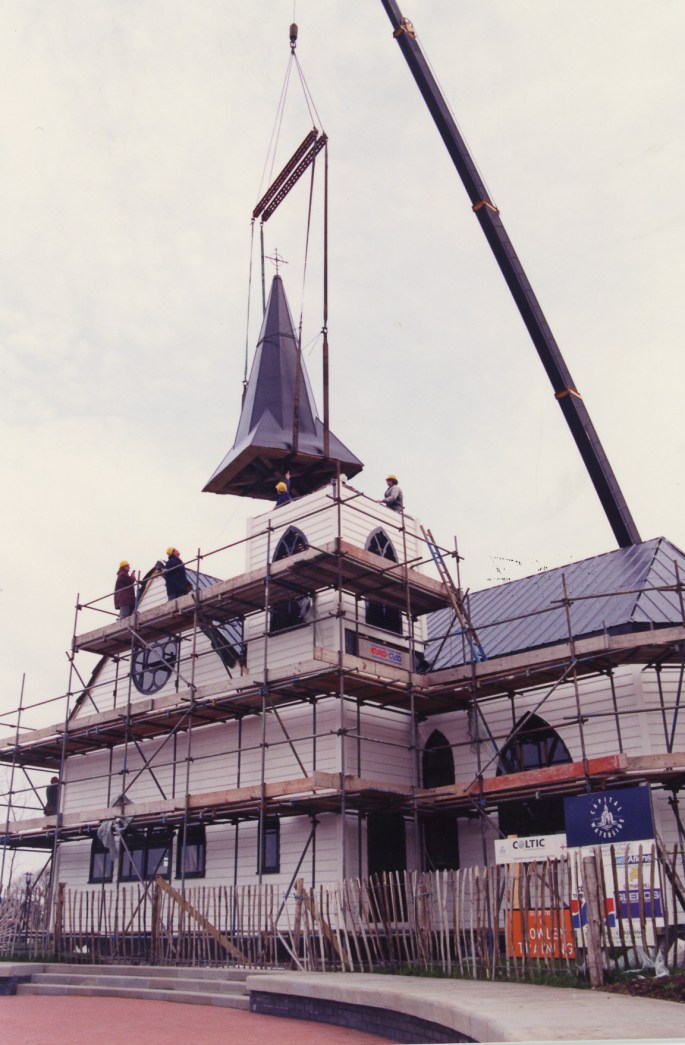
At that time the building looked quite sad at its old site at the head of the Bute East Dock. Its decaying corrugated iron cladding belied its fine interior. It just had to be renovated to take its rightful place as an important part of Cardiff’s history. In 1987, it was dismantled and put into storage ready to be reassembled on its new site. The group worked hard, and forged links with the seafaring community of Hordaland, which includes the historic seaport of Bergen on the west coast of Norway. Aware of its links with the Welsh Norwegian community, Hordaland contributed £250,000 to the project.
The enterprise was a stupendous success. The church was rebuilt in its current position. The old, corrugated iron cladding had been a condition imposed by the nineteenth century port authority, and it was replaced by traditional timber painted a sparkling white. In April 1992, the building was reopened by Princess Martha Louise of Norway in the presence of the Norwegian community and the civic dignitaries of Cardiff. Signe was given a lift to Central Station in the mayoral car, an event now firmly ensconced in our family saga.
The enterprise was a stupendous success. The church was rebuilt in its current position.
The old church immediately commenced its new role as an Arts Centre and preserving the memory of the ships and men that hauled pit props from Norway and took coal home again. It was also creating strong links between Wales and Norway.
One of the by-products of the enterprise was the Sunday group. I call it that because it met on the last Sunday of each month at the church. It was made up of the remaining members of that original group which set out to save the building, funded by a bequest from Ellen Greve to enable members of the group to maintain contact with each other.
There was Ellen, Stan, Ebba, Mary Allen, Sid Eide, Deris and Hugh Deeks, and Averil Goldsworthy who was chair of WNS from 2003 to 2017. There were so many interesting people to chat with, like the musician, the late Mr. Nichols and his son and daughter in law, David and Pauline.
We would enjoy good coffee, Norwegian style cakes, waffles, and a good old chinwag about our experiences of Norway and her people. The highlight of the afternoon was drawing the raffle. We all contributed a prize, and most of us went home with one. Our son Gareth used to assist Stan in selling the tickets, making the draw and calling out the winning numbers. It helped the growth of his self-confidence no end.
The ancient Norse gods must have approved of the event.
Then there was the Midsummer Garden party, traditionally held in Ebba’s spacious garden in Sully. Ebba, her family, and friends would furnish a sumptuous buffet. Betty and Peter Persen were prominent memories, and Peter, who became president of the Society, would light the traditional bonfire. The ancient Norse gods must have approved of the event for only on one or two occasions were we obliged to seek refuge from the rain in Ebba’s beautiful home.
The seventeenth of May was, of course, a special event with all flags flying around the church. Around 2006, Karen Allen, the Society’s development officer, started the tradition of parading from the Wales Millennium Centre through Cardiff Bay to the Church. In the evening, all the members of the Society met for a meal, provided by the caterers who ran the Norwegian Church coffee shop. Society members contributed to the menu by supplying their own mulled wine, starters, and gateaux to ensure things could be as authentic as possible. We were never disappointed.
Christmas was celebrated with a whole day event lighting the Christmas Tree and singing the Norwegian national anthem. Evening saw us enjoying another delightful Christmas meal with akvavit served by Erling and Sylvia Lindoe.
We danced around the Christmas tree and sang carols to Mrs. Carol Roese’s accompaniment. Mrs. Barbara Bailey sang for us, she and her husband Colin regularly making the trip from Magor. Even when Colin became wheelchair bound, they managed to make the trip.
It was at one of these events that I first met Solveig Borthwick, and her husband, Don, who was the Society’s first chair. Tony and Carole Olavesen, Alan Milne, and Alan Hall were other new friends made at these events. Alan Hall taught at Atlantic College, and we were frequently joined by Norwegian students at who were always a joy to chat with.
In 2002 we celebrated the 10th anniversary of the reopening of the Norwegian Church. We were joined by Bodø Cathedral Choir, led by their charismatic conductor, Magne Hansen. He had the choir encircle the audience in Llandaff Cathedral which created a very special sound. They sang for us at Ebba’s Garden party, and at the church, first from the balcony before proceeding down the stairs to the hall. The Society also arranged for them to perform in St David’s Cathedral which the choir thought was very special.
In 2022 the new charity Norwegian Church Cardiff Bay (NCCB) officially took over the Norwegian Church Arts Centre in Cardiff Bay from the former Norwegian Church Preservation Trust.
One of the charity’s main aims was to establish a heritage programme at the church, highlighting the history of the Norwegian Seamen’s Mission in Wales (in addition to the church in Cardiff Bay, there were other churches located in Newport, Swansea, and Barry), historical connections between Wales and Norway, and the more recent history of the church.
In the autumn of 2022, before the NCCB took over, the Welsh-Norwegian Society sent out a call for volunteers to help realise this heritage project. My wife Olivia Husøy-Ciaccia and I offered our assistance as volunteers for this project. With support from the Chair of NCCB, Martin Price, we were tasked with writing a funding bid to the National Lottery Heritage Fund to gain the financial means to execute the project. At the time (and at present), I held the role of Treasurer of the Welsh-Norwegian Society. The funding bid was successful and through it the NCCB obtained the funds to hire a professional Heritage Officer, a role which I was delighted to be offered.
Since September 2022 it has been my responsibility to conduct research and collate as much of the historical information about the church as possible. This brief introduction provides the background to how the heritage project came to be. For the remainder of this article I will highlight two recent developments in the project so far, starting with the new digital touchscreen kiosk, now in the Norwegian Church.
The Digital Touchscreen
One of the most important aspects of the heritage collation project at the Norwegian Church Arts Centre is to make as much information about the church available to the public as possible. One of the new devices we have purchased to achieve this is a digital touchscreen, which is now in the church. This has been installed with historical content provided by Tiger Bay – Heritage and Cultural Exchange, which is collaborating in the heritage collation project.
The information on this touchscreen kiosk currently tells the story of Cardiff Bay over the last few hundred years. A similar touchscreen can be found at Craft in the Bay, which also features the material supplied by Tiger Bay HCE.
Our touchscreen will focus on the history of the Norwegian church in Cardiff, but will also feature some information about the Norwegian Seamen’s Church and its Missions in Swansea, Barry, and Newport. Additionally, it will shed light on the social history of Norwegians in South Wales, including the history of the Welsh-Norwegian Society.
The screen has already received keen interest from visitors and we hope that it will become even more popular once it is fully populated with historical information and images, which will be available in English, Welsh, and Norwegian.
Research trip to Norway
As I write, I am currently on a two-week research trip to Bergen in Norway, where I am visiting the Seamen’s Church’s archive and museum, the Maritime Museum, and the Regional State Archives in Bergen. These are three institutions which hold relevant material for the heritage project.
I spent the first days of the research trip in the historical collections of the Seamen’s Mission, which has important documentation on the history and development of the church. They have a large photo archive as well as a complete collection of Bud og Hilsen, which is the journal of the Seamen’s Church. The first issue of this journal dates to 1865, and in earlier numbers often contained reports from the various missions entitled “Fra Cardiff” (from Cardiff) or “Fra Antwerp” (from Antwerp); these supplied very useful information about historical developments and affairs and the various Norwegian churches across the world. They also have anniversary books produced about the Norwegian Seamen’s Church throughout its history which provide useful summaries of the historical developments at the various stations, including Cardiff.
At present the Norwegian Church Arts Centre has a modest number of artefacts from its history on loan from the Seamen’s Church’s historical collection, such as the historical baptismal font and some candlestick holders. The latter were given to the Cardiff Church by Hvaler Parish Council in 1927.
I have also spent time at the Maritime Museum in Bergen, where I consulted more issues of Bud og Hilsen as well looked through parts of their extensive photography collection and reference sections. The second week of the trip will be used looking at the collections related to the church held by the Regional State Archive in Bergen, which holds an extensive collection related to the Norwegian Churches in South Wales and further afield.
HERITAGE Exhibition in the NORWEGIAN CHURCH
As a part of this project, we are aiming to create an exhibition to open on May 17th focusing on the history of Norwegians in Wales.
If anyone would like to lend any items to support this exhibition or help us to organise it, please contact me at thomas@norwegianchurchcardiff.com. These items could be an old artefact, photos, home made crafts, etc.
Everything will be carefully cared for, documented and returned after the exhibition closes.
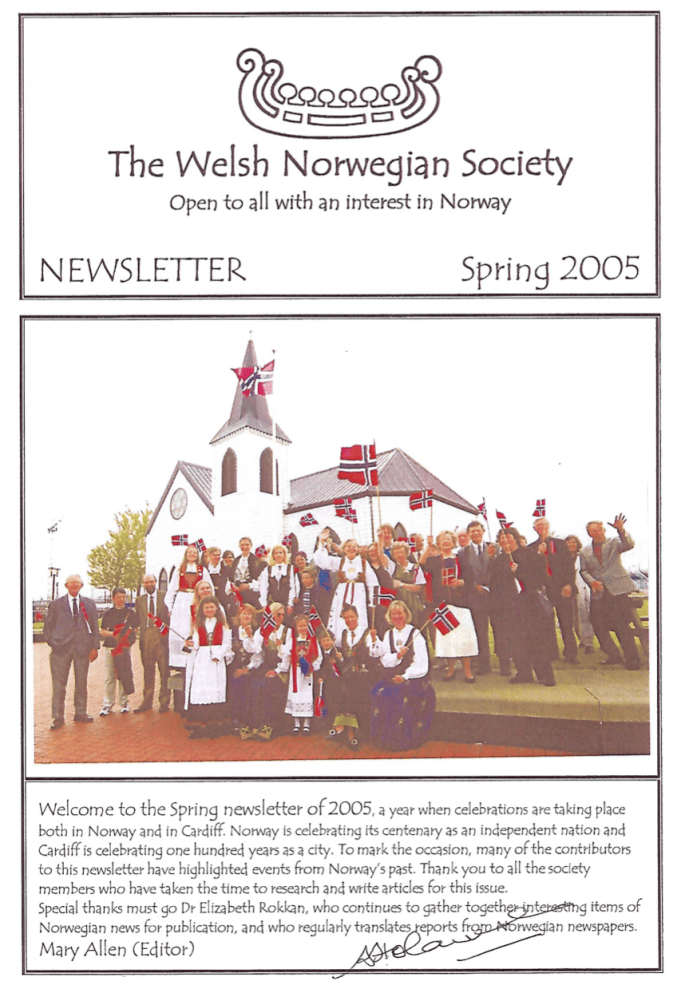
Welcome to the Spring newsletter of 2005, a year when celebrations are taking place both in Norway and in Cardiff. Norway is celebrating its centenary as an independent nation and Cardiff is celebrating one hundred years as a city. To mark the occasion, many of the contributors to this newsletter have highlighted events from Norway’s past. Thank you to all the society members who have taken the time to research and write articles for this issue.
Special thanks must go Dr Elizabeth Rokkan, who continues to gather together interesting items of Norwegian news for publication, and who regularly translates reports from Norwegian newspapers.
Mary Allen (Editor)
Dear Members,
Thank you to everyone who has attended our monthly events so far this year.
My feedback is that everyone has enjoyed the varied programme, plus the refreshments, which we have from time to time during or after these events.
In this special centenary year, we look forward to a good 17th May, SYTTENDE MAI, and also ST. HANS garden party on 26 June, 2005.
Best Wishes, Averil Goldsworthy Chairman
UK and Norway’s Independence From the Ambassador of Norway, in a letter to The Times, March 2005
Sir, Exactly 100 years ago, on March 25, 1905, ‘The Times’ published a letter from Mr Fritjof Nansen, the Norwegian polar explorer. This letter represented the start of an important political campaign to win the support of Britain for a break-up of the Union between Norway and Sweden, which had lasted since 1814.
The campaign was successful. The crucial support of this country was secured. The formal recognition was given in a telegram sent on October 30 to Oslo by the Foreign Secretary, Lord Lansdowne. Fritjof Nansen became the first Norwegian Minister to the Court of St. James’s.
During 1905 two referendums took place. The first was on the question of whether or not to separate from Sweden. An overwhelming majority voted for independence. The second was on whether an independent Norway should be a republic or a monarchy. More than 90 per cent voted in favour of a monarchy.
The Storting (parliament) decided to invite a Danish prince to accede to the throne and, accompanied by his wife Queen Maud and their son Crown Prince Olav, King Haakon set foot in Norway on November 25. Queen Maud was King Edward VII’s youngest daughter. The fact that a British princess was King Haakon’s wife was significant, both in the choice of the new King by the Storting and the decision in London to support Norway’s struggle for full independence.
Britain and Norway share more than a thousand years of common history. The events in 1905 underlined the importance of these ties. Since then we have continued to come closer, not least during the Second World War.
The special visit that the King and Queen of Norway will pay to London in October at the invitation of HM the Queen will undoubtedly underline our special affinity.
Yours,
TARALD O. BRAUTASET, Royal Norwegian Embassy, 25 Belgrave Square, W84QA.
HE The Norwegian Ambassador, Tarald O. Brautaset Photographed at the Norwegian Church Arts Centre, April 2004 at the ceremony to honour Ewart Parkinson with the St. Olav’s Medal
Newsletter Contributions
Please send items for the Newsletter to: Mary Allen [address redacted]
All items will be considered for publication, but it may be necessary to edit articles on occasions. The deadline for the Summer newsletter is 10th June 2005.
Syttende Mai 2005
This year’s celebration of Norway’s Constitution Day promises to be a very special occasion, in Norway’s centenary year. Information will be sent out at the end of April and we advise booking as quickly as possible to avoid disappointment!
Notes From A Small Cupboard
A regular report from the Norwegian Church Cultural Centre by Karen Allen
From Arts to Culture
You may have noticed the change of name from Norwegian Church Arts Centre to Norwegian Church Cultural Centre. We decided that such a name change was a good way to begin this important year, partly because we felt the word ‘cultural’ more accurately reflected the diverse range of activities that now take place in the centre, but also because the word ‘cultural’ is very similar to the Norwegian word ‘kultur’ thus enabling Scandinavian visitors (and organisations that we may contact in Norway) to understand what the Norwegian Church is used for now.
My understanding is that ‘kultur’ is a very broad, inclusive word in Norwegian, which is used for all sorts of community activities relating to arts, culture and heritage, and that seemed very appropriate to our unique venue, especially as the diversity of our programme is something that is so often noted.
Norway 2005 & Cardiff 2005: A Celebration of Two Centenaries
During 2004 we frequently mentioned, in this newsletter and elsewhere, the rather neat coincidence that both Norway and Cardiff would be celebrating centenaries in 2005; Norway as an independent nation and Cardiff as a city.
In fact it seems as if we have been talking about the double centenary for some years now! The Norwegian Ambassador Tarald Brautaset first drew our attention to Norway 2005 during his first visit to the Norwegian Church in the autumn of 2001. We immediately commented that 2005 would also be a significant year for Cardiff (the celebration of 100 years as a city and 50 years as the capital of Wales). From that moment on, the idea of organising a series of events throughout 2005, in celebration of the historic and contemporary links between Wales and Norway, began to take shape.
And so here we are, in the spring of 2005, and I’m pleased to report that the Arts Council of Wales have awarded a generous grant for a series of Scandinavian music events which will take place through the year (some are listed on the opposite page), plus an applied arts exhibition from Norway, and a Friendship Blanket project which will involve the Glamorgan Guild of Spinners & Weavers working together with a weaving group from Hordaland to produce a single woven blanket which will be exhibited in both Wales and Norway.
Other exhibitions are planned including the results of a photographic project that involved Norwegian photographer Toril Brancher (Toril lives in Abergavenny) working with young people in Blaenavon – they were given cameras and asked to record images that reflected their daily lives.
A group exhibition of artwork based on the theme of the Vikings will take place in the autumn and we’re delighted that David Petersen (Wales’ most famous Viking!) will be one of the artists taking part.
We will also be organising a children’s writing competition, thanks to the generosity of Hordaland Fylkeskommune, who have donated two trips to Norway for the winning children and their families.
As this newsletter goes to print, we are awaiting confirmation of funding for a photo-documentary project inspired by Trygve Sørvaag’s Shetland Bus project. Further details of this project will be announced but in the meantime we are looking for people in Wales and in Norway who have memories of visiting the Norwegian Seamen’s Churches in Cardiff and Swansea.
2005 Events
Other events are being planned as this newsletter goes to print. We will keep you posted!
Friday 6th May 8pm
SILD: Welsh-Estonian Folk Duo
Presented in association with Wales Baltic Society to mark the first anniversary of the Baltic countries joining the EU. Supported by the Arts Council of Wales.
Tickets £7 (concessions £5) from BBC NOW 0870 013 1812
Tuesday 17th May
SYTTENDE MAI: Norwegian Constitution Day
The most important day in the Norwegian calendar.
Daytime event: Meet outside the Wales Millennium Centre at 10am for Syttende Mai procession via Roald Dahls Plass to the Norwegian Church. Celebrations at the Norwegian Church start at 11am. All welcome; admission free.
Evening event: Welsh Norwegian Society Syttende Mai Dinner
Advance booking essential. Contact Shuna Lovering on [telephone redacted] for further information.
A concert to mark the 100″ anniversary of the day the Norwegian Storting (parliament) declared that it was to dissolve the Union with Sweden.
Supported by the Arts Council of Wales
Tickets £10 (concessions £8) from BBC NOW 0870 013 1812
Sunday 3rd July
KARL SEGLEM QUARTET: Norwegian saxophonist & composer
Supported by the Arts Council of Wales
Tickets £10 (concessions £8) from BBC NOW 0870 013 1812
NB. This was initially advertised as 1st July and has now changed to 3rd July
Tuesday 27th September 8pm
CHRISTIAN WALLUMRØD ENSEMBLE featuring Nils Økland & Arve Henriksen Supported by the Arts Council of Wales
Tickets £12 (concessions £10) from BBC NOW 0870 013 1812
Friday 21st – Sunday 23rd October
SCANDINAVIAN DANCE & MUSIC WEEKEND
Presented in partnership with Pentreffest: Contact [redacted]
Supported by the Arts Council of Wales
Sunday 30 October 8pm
SWAP
Hugely popular Anglo-Swedish quartet, returning for a fifth appearance at the Norwegian Church! Supported by the Arts Council of Wales
Tickets £12 (concessions £10) from BBC NOW 0870 013 1812
Confessions of a Panto Virgin
by Mari Ropstad
Mari is a student at the School of Journalism, Cardiff University. This article was written for her occasional column in the Western Mail, and is reproduced here with the kind permission of both Mati and the Western Mail.
Growing up in Norway has its advantages. From the tender age of three, I was dragged out into the cold by my parents so that I could learn to ski once and for all. Thanks to my Norwegian heritage, I know what to do if my car finds itself on pure ice and I understand that there’s nothing wrong with eating reindeer, with the exception of Rudolph, of course. But what I don’t know anything about is the traditional Christmas pantomime.
Having lived in Wales for almost three years now, you would be excused for wondering how I managed to get through two festive seasons without at least finding out what a panto entails. The truth is I never actually knew pantomimes existed until earlier this year when I did an interview with the great Welsh panto dame Wyn Calvin. As we were chatting away about Widow Twankey and Buttons I became more and more confused: there was never a widow in the Disney-produced Aladdin which I was familiar with and I’m sure there was no one called Buttons in the Cinderella fairytale.
In blind panic, I asked the Welsh Prince of Laughter what exactly panto was. After a long silence, Wyn told me that I would never fully comprehend the Welsh or British character unless I experienced the folly of a Christmas panto. ‘It’s impossible to explain to any foreigner what panto is about – believe me, I’ve tried,’ he said. ‘It’s just too bizarre. You simply won’t get it unless you go and see it for yourself.’
And that’s exactly what I intend to do. Trying to prepare myself for what could easily be a traumatic experience I have asked a great deal of people about panto, doing my best to hide the fact that I know nothing about it. I have had various descriptions of what this weird art form entails, but what seems to be a generally held opinion is that it’s almost like interactive theatre. Booing and hissing have been mentioned to me a great many times and to be perfectly honest it frightens me that I don’t know how to boo or hiss.
I hold the firm view that theatre is there to be watched not participated in and that the stage is a place for very brave people. Other than that, I have managed to pick up that the women are usually played by men and vice versa.
Instead of worrying about whether or not I’ll get the timing of my hissing and booing right, I’ll try to think of panto in a way by which my Norwegian brain can deal with. I say to myself that panto is just like a snowstorm: no one may have told you beforehand that the right thing to do is to dig yourself into the snow, but that will become pretty damn obvious once you find yourself in the middle of a life-threatening whiteout.
With so much on offer it seems my biggest problem will be choosing which panto to see first.
The Anglo-Norse Society, London Meeting held 17 March at the Norwegian Embassy
Prof. Olav Riste, at the invitation of the Society, lectured on the Norwegian Constitution of 1814 and the significance of the Norwegian Secession from the Union with Sweden in 1905. Prof. Riste is currently Research Director of the Institute for Defence Studies and adjunct professor of History at the Universities of Oslo and Bergen. He focussed on aspects of Norwegian foreign affairs, emphasizing the importance of the reactions of Britain and Germany during the early years of the twentieth century when recognition of Norwegian independence was vital for trade and shipping interests.
Although there was a strong desire for an isolationist foreign policy, and traditional mistrust of the British since 1814, this was mitigated by the introduction of parliamentary practices in government in the 1880’s and an increase in trade to the U.K. until it was 2-3 times greater than to Germany. This led to Norwegian demands for control of foreign treaties and the establishment of a separate consular service in 1891.
There followed the referendum (to show other countries the strength of Norwegian opinion); this resulted in almost 100% of voters in favour of secession. The minority of Republicans was not large enough to prevent the reestablishment of the monarchy. The preferred policy of neutrality enabled Norway to avoid taking part in WW1, but enabled Germany to occupy the country in 1940. The subsequent flight and exile of King Haakon and his government made London the focus for Norwegian opposition until Liberation in 1945.
Elizabeth Rokkan.
Forthcoming Anglo-Norse Society Events
May – June
Nansen Seminars: Manchester, Cambridge, Norwich
September
100% Norway 2005: Norwegian design as part of London Design Week
September – December
Edvard Munch By Himself: Self-portraits by Edvard Munch exhibited at the Royal Academy of Art, London
November
Norwegian Day at the Huddersfield Contemporary Music Festival
Norwegian music all day and three concerts in the evening
December
Norwegian Voices at the Barbican Centre
Details of other Norwegian cultural events taking place across the UK, to mark Norway 2005, can be found on the Norwegian Embassy website http://www.norway.org.uk
Bergen and the German Hansa by Ellen Greve Wayne
Those of you who know Bergen well will probably know of the Hanseatic Museum in Bryggen.
In the 12th century German merchants began trading with Bergen. From artefacts that have been found, it points to them having come from West Germany. When trading actually began isn’t known precisely but in the 1240’s there was a conflict between Bergen and Lübeck which led to the exchange of diplomatic notes. The import of grain, flour and malt from Lübeck to Bergen had now been established but the German merchants were unhappy with the constraints put on them by King Håkan Håkansson. However, in 1250 a peace treaty and trade agreement between King Håkan and Lübeck was concluded and the Norwegians and Lübeckers could engage in free and mutual trade.
Originally the Germans who came to Bergen stayed for a time, to buy and sell their goods and then returned home. But after the treaty of 1250, individual Germans started to take up winter residence and began renting accommodation on Bryggen. Shortly afterwards one became the first German to buy a house on Bryggen. This sowed the seeds for the Hanseatic trading station that was to become firmly established in Bergen.
By the 1300’s, German craftsmen began settling in Bergen, such as shoemakers, goldsmiths, bakers, tailors, barbers and furriers. All these traders organised themselves into separate guilds. The urban code of 1276 gave foreigners an equal footing with Norwegians as regards both rights and public duties. However, the Germans eventually became dissatisfied with their legal situation in Bergen and wanted it made clear that they were also given the same protection by the law.
In the years that followed, the legal protection given by the Norwegian law was made expressly applicable to the Germans and to a certain extent adapted for them. They were to be allowed salvage rights to their goods when these were lost through being shipwrecked on the Norwegian coast.
In the second half of the 13th century, they were establishing themselves in the traditional sea trade between Bergen and the East English seaports. In fact by the 14th century it appears that they had come to dominate this trade ahead of the British & Norwegians. Also custom records from the 1320’s indicate that active Norwegian participation had virtually ended. By the late middle ages Norwegians no longer played an important role in Bergen’s foreign trade.
Over the years the German traders established themselves as a strong force in Bergen and amongst themselves they set up Kontors, which held strong political sway in the community. They had their own rules of practice and even chose their own alderman. The monarchy had not relinquished its principle that foreigners in town should be placed under Norwegian jurisdiction, but the Germans had become so strong that it was impossible to prevent them from organising themselves and settling their own disagreements independently of the Norwegian authorities.
The settlement on Bryggen consisted of long, parallel rows of houses running perpendicular to the harbour. Most were organised into ‘double’ tenements, i.e. units consisting of 2 rows of houses with a common passage between and common quay space in front. Some only had a single row of houses and passage. In the Middle Ages there were about 30 such tenements or ‘gårder’ in Norwegian. By the 16th century this had reduced to about 20. They didn’t own the land but, as long as a Kontor existed, they paid ground rent to Norwegian landowners. Norwegians and other foreigners began to move out of Bryggen and then transferred their businesses to other parts of town and to the rapidly expanding areas around the head and along the opposite side of the harbour.
The Kontors were in charge of trading units or firms, each of which occupied their own premises within a tenement. There were storerooms as well as living rooms, sleeping quarters and workshops, and they all had access to the common facilities of the ‘gård’, i.e. the quay space in front, the private passage, the equipment for brewing ale, the common kitchen and the common room in the rear of the gård. The order of rank, among the Germans of the Kontor, was fixed and discipline strict. The apprentices were normally peasant boys from N. Germany, many of them relatives of the Hanseatic merchants. They received practical training and schooling at the Kontor and had the opportunity to work their way up. From the second half of the 15th century, it appears that there were rather brutal initiation rites, aimed at keeping open the way up for people of humble origin and to frighten away people who were safe and spoiled.
Germans were not allowed to marry in Bergen, so as to retain the trade dominance in German hands. Since women were not allowed into the Hanseatic tenements, the Germans took care of all the work and housework. The number of German residents at the Bergen Kontor numbered approximately 1,000 by the end of the middle ages, plus some 200 German craftsmen outside the Kontor and numerous Hanseatic guests, merchants and sailors, who visited Bergen in the sailing season. At its seasonal peak the number of Germans may have reached 2,000 or more, a high figure for a town whose population never exceeded 7,000 in the middle ages. Because of the ban on intermarriage some Germans kept mistresses with whom they had children.
Norwegian historians have often taken a negative view of the role played by the Hanseatic merchants but they had a positive economic influence on Bergen and on Norway as they created and expanded an assured market for fish and other domestic products, thus making Norway larger. They also put their stamp on the cultural heritage of Bergen. The German Kontor in Bergen lasted for a total of 156 years after the closure of the London Kontor. Elis 1st closed the London Kontor in 1598. Grand Duke Ivan the 3rd of Moscow closed the Kontor in Navgarad in 1494. In 1585 the Brugge Kontor was closed.
The Bergen Kontor was kept alive for many reasons and, after the 1800’s the Kontor gradually became more Norwegian and the number of Norwegian apprentices increased. In 1899 the Norwegian Kontor was disbanded with the commencement of a new fishing and trade era. Steam ships were taking over and bigger and better quays were needed.
The people of Bergen regarded themselves as special compared to other Norwegians and Bergen as a unique town. There is a strong historical reason for this feeling, due to the presence of the German Kontor and the strong German influence in the Norwegian Kontor for over 500 years, as well as the influence of the German immigrants and the development of a separate body of Burgesses from the 16th Century onwards. The arms of the city of Bergen bear a strong resemblance to those of the various Hanseatic towns in Germany.
The German influence can still be found in modern Bergen. Their trade and craft skills meant that their descendants were soon found among the upper classes in the town, and they became a decisive force in the government of the town and its cultural life right up to the present day. German names can still be found over the doors of many shops and businesses. The German Kontor in Bergen was a unique institution in Norway thus making Bergen unique among the Norwegian towns and cities.
(All facts and figures taken from ‘Bergen and the German Hansa’)
[illustration]
The German Kontar in 1817. Water-colour by JFL Dreier
A Tribute to Dr Ole Dramdal
In October 2004, we received the sad news of the death of Dr Ole Dramdal, former Leader of Hordaland Fylkeskommune. Dr Dramdal’s support of the Norwegian Church Preservation Trust was an act of great generosity. He had the vision to see that the rebuilding of the derelict Norwegian Seamen’s Mission Church on a new site near the water would rekindle the strong sense of friendship that had existed for generations between Norwegians and the people of South Wales. His statement at a dinner in Bergen on January 29th 1991 that his Church Support Committee would raise, in Norway, the sum of one million kroner towards the rebuilding of the Church in Cardiff was astonishing and wonderful. From that day on the rebuilding of the Church was assured. Now it is a very lively cultural centre and the base for the Welsh Norwegian Society. It is growing and widening its range of activities all the time. Everyone who enters the Church sees the Foundation Stone which records its laying by Dr Ole Dramdal in September 1991. All of us will treasure his friendship and support over the years. We were so sad to learn of his death.
Ewart Parkinson Ole Dramdal is pictured with Duncan Longden on page 13
More Memories of Mervyn Amundsen, 1927-2004
by Duncan Longden
Mervyn and Peter Persen were two of the most supportive members of the early committee who wished to rebuild the church as a focal point, that is, to rebuild the social and cultural links with Norway. The enthusiasm and encouragement of the whole of that committee helped me to find widespread support, both in Wales and Norway.
Mervyn made many models of the church, one of which he made on a straw boater, which I wore on my sponsored walk to Cowbridge. We can always do with Mervyn’s brand of enthusiasm. I am sure that he will be much missed by his many friends.
The late Mervyn Amundsen, pictured with one of his models of the Norwegian Seamen’s Church
News In Brief
New University
On 17th January, 2005, King Harald opened the new University of Stavanger, based on the former Distriktshøyskole (or Regional College), in the presence of the Minister of Education, the District Governor of Rogaland, the Mayor of Stavanger, the Chairman of the District Council, the Bishop of Stavanger, the Rektor and Director of the University, the Deans of the three faculties, and student representatives. In his speech King Harald emphasized that universities are decisive elements in the foundation of nation building. The University of Oslo was established in 1813, a year before we were given our own Constitution. The University of Stavanger has been achieved in 2005, the year when we are celebrating our first centenary as an independent nation. It is a valuable gift to those who will continue building our country during the next hundred years.
Translated by Elizabeth Rokkan from Stavanger Aftenblad, 18th January 2005
The Shetland Bus
Trygve Sørvaag, the author of ‘Shetland Bus: Faces and Places 60 years on’, has established a press agency in London together with five Norwegian colleagues. Already trained as a journalist in Norway, he came to Britain seven years ago to study photography. At first he worked as a freelance journalist, sending his material to newspapers and technical journals in Norway, but last year he set up the Scandinavian Press Agency Ltd. to provide the Norwegian press with special reports and background material related to routine news events. He is a member of the committee of the Foreign Press Association, which provides him with useful contacts through its membership of 700 foreign correspondents.
Some of the photos displayed in his office are ones that he took of refugees making their way through the Euro-tunnel. These have been used by ‘Time Magazine’, the ‘New York Times Magazine’ and the weekend edition of ‘The Guardian’. Sørvaag is originally from the island of Karmøy, near Haugesund.
Norwegian edition: ’Englandsfer’
Translated by Elizabeth Rokkan from ‘Månedsbladet’ (the magazine of the Norwegian Seamen’s Church in London), issue no. 1, 2005, vol. 68
Ecumenical Service at St. Olav Church, Rotherhithe
On January 21st, 135 Catholics, Lutherans and Anglicans attended an ecumenical service at the Norwegian Seamen’s Church in London as part of the Week for Prayer for Christian Unity, a tradition which dates from 1908. This year the preacher was the Roman Catholic Archbishop of Southwark, Kevin McDonald, who was presented with a gift of two candlesticks by Father Helge Pettersson. Previous preachers at the church have included Archbishop George Carey of Canterbury and Cardinal Basil Hume. The readings were in Norwegian, English, Swedish, Portuguese and sign language for the deaf.
Translated by Elizabeth Rokkan, from ‘Månedsbladet’, issue no.1, 2005, vol. 68
Appointment
Torbjørn Holt has been appointed Seamen’s Chaplain and Administrator at the Rotherhithe Church in London.
Lobsters Feel No Pain
Norwegian scientists were asked to investigate pain, discomfort and stress in invertebrates and claim now to have discovered that the answer is no. Their conclusion applies also to crabs and to live worms on a fishhook. None of these creatures feel a thing, which is good news for Norwegian fishermen since the Norwegian government was considering placing a ban on live worms as fish bait, under revisions to its animal protection laws – but only if it hurt. Professor Farstad, who chaired the panel that prepared the government report, said that invertebrates do not feel pain because they have basic nervous systems and small brains.
The Guardian, 8th February 2005
Hollywood Studios Hit By Dahl Mania
Prominent Hollywood directors, along with stars such as Johnny Depp and John Cleese, are anxious to put Roald Dahl’s work back into cinemas in 2005. ’Charlie and the Chocolate Factory’ is being finished by the cult director Tim Burton at Pinewood Studios, for release on July 15, with Helena Bonham Carter as Mrs. Bucket and Johnny Depp as Wonka. Burton is making a much darker version of the story than that portrayed in the original film.
Another renowned director, Robert Altman, is adapting some of Dahl’s macabre adult stories into a six-part television series, on the lines of ITV’s’ Tales of the Unexpected,’ broadcast in the late 1970s.
Wes Anderson, another prominent director is turning Dahl’s ‘The Fantastic Mr. Fox” into a movie at the Revolution Studios. Also ’Shrek’ producer John Williams is making a film of ‘The Twits’, with the script written by John Cleese who is also hoping to star in the movie.
Yet another film is being made by Paramount of “The Big Friendly Giant, with the script by Ed Solomon who wrote ‘Men in Black’.
The Daily Telegraph, 29th November 2004
Visitor Remembers Roald Dahl
A retired teacher who visited the Norwegian Church in Cardiff in early March 2005 recalled Roald Dahl giving out the prizes in his school on Speech Day. He remembered how Dahl captured the minds of the children at once and was able to adapt to their level so easily. His own granddaughter won a prize for a short story, and when she sent it to Dahl, he wrote back and suggested a more macabre ending!
Sophie Reappears as a Real Dahling
Sophie Dahl was once the champion of large, curvaceous women everywhere. Then she changed her image dramatically to conform to the stick insect, size six norm. But, now, the 25-year-old model and granddaughter of author Roald Dahl, looks fit and healthy as the cover girl on ‘Harpers & Queen’ magazine. She now poses in a size 10, sequined dress, designed by Julien Macdonald. Editor Lucy Yeoman says that her new image suits her much better and it is hoped that she has moved away from the super-slim figure, who fainted three times as she left a dinner in New York last year.
Western Mail, 12th February 2005
Duncan & Mary Longden to visit for 17 May Celebrations
Duncan and Mary Longden will be making the long journey to Cardiff, from their home neat Hull, to take part in the Syttende Mai celebrations.
Duncan was the Councillor of South Glamorgan County Council who threw his weight behind the drive to save the Norwegian Seamen’s Church in the mid 1980s. He was tireless in campaigning to rescue the little white church from demolition and even undertook a sponsored walk to Cowbridge, wearing a straw boater with a model of the Norwegian Church on top! (Duncan refers to this hat in his tribute to Mervyn Amundsen on page 10). Not only did this sort of activity raise funds, it also captured the attention of the press and earned valuable coverage particularly in the South Wales Echo, the paper that Duncan still remembers as a good supporter of the campaign.
Duncan and Mary anticipate that this will be their last trip to Cardiff, as they are finding it harder to get around these days, and would like to meet up with as many friends and former colleagues as possible. They will be based at the Norwegian Church for the day on Wednesday 18th May, and anyone who would like to see them is welcome to join them in the Norwegian Room for coffee and cake.
Dr Ole Dramdal and Duncan Longden, pictured at the laying of the foundation stone on the new site for the Norwegian Church in 1991.
Christian II: The Reformer King
King of Norway, 1537-1559 by Allan Paterson Milne
Christian made his first and last visit to Norway in 1529. The Young Prince – then in his mid-twenties – came seeking recognition of his right to succeed to the Norwegian throne. He did not have much luck.
Christian was too well known for his sympathy with Lutheranism. He had actually been present at the Diet of Worms in 1521, when Luther had made his famous ‘Here I stand’ speech before the Emperor Charles V.
Thus the men of power in Norway, both laymen and bishops, greeted him with suspicion. He would, it seemed, get no support from them. Still, his retinue did not leave empty-handed. They plundered Oslo Cathedral, which very conveniently combined a blow against popish error, and the seizure of enough loot to cover the expenses of the trip. Even so, it was an ideal way to win ‘hearts and minds’ in Norway.
When King Frederick I died in 1533, a bloody religious war broke out in Denmark. Christian and the Lutheran faction were victorious. Christian took the throne as Christian Ill and carried through the Reformation in Denmark.
But what of Norway? The country had hardly any Protestants at all. Protestantism, generally, flourished among the self-confident, literate laity in the towns. Norway was, by contrast, a sparsely populated, decentralised land given over to farming and fishing. Only in Bergen was there much interest in the reformed religion, and Bergen was practically a German town at this time.
Thus it was that the Archbishop of Nidaros, Olav Engelbriktson, raised the standard of revolt for a ‘Catholic, Free and Independent Norway.’ Somewhat surprisingly, this rousing and magnificent call to arms fell almost completely flat.
Hardly anyone mustered to fight under the Archbishop’s banner, and his attempt to seize Akershus castle was a failure, as was a similar effort to capture the fortress at Bergen. He was forced to flee abroad in 1537. The dismal failure of this uprising seems strange, but Christian probably undercut the revolt with his promises to govern Norway according to her old laws.
Old laws or not, however, Christian was going to take no chances over Norwegian independence. Norway was proclaimed to be part of Denmark ‘forever’ and a separate Norwegian coronation done away with. Despite this, Christian seems to have been popular in Norway. He was always ready to hear Norwegian petitions and complaints, and began to curtail the Hanseatic stranglehold on Norway’s foreign trade. He was also the founder and promoter of what became a growing Norwegian mining industry.
Yet Christian was probably quite unaware of the main benefit he would confer on Norway. The Reformation made it necessary to bring in Lutheran clergymen from Denmark. These taught and preached in Danish, a language which many of their parishioners barely understood. The result of this was the emergence of a distinct Norwegian-Danish language, which could express complex ideas but which was also clear, direct and straight to the point. In its modern form, ‘Bokmål’, it has become the language most Norwegians speak.




 Welsh Norwegian Society