We are deeply saddened to share the news that our dear friend and stalwart member of the society, Dr Ken Davies, has passed away. We know you will want to join us in sending heartfelt condolences to Ken’s surviving sons Robert and Gareth. Another son, Hwyel, predeceased him. Ken’s beloved wife Signe died in 2021.
Ken was a man of many talents and broad interests. Born in 1940 in Ffynnongroyw in north Wales, he left school at sixteen to go to sea. On his travels he met and married Signe, a Norwegian, and they spent time in Norway before settling in north Wales. Ken returned, aged 36, to college to get the further education he had missed two decades earlier. He studied psychology, sociology, history and linguistics, and also developed his interest in economics, industrial relations, politics, philosophy and literature. He studied further in Swansea, Birmingham and the Open University as well as teaching himself and spending many years working with disadvantaged people.
Ken wrote many academic papers and articles, firstly on his professional interest, but later broadening into maritime and local history. He wrote books on his beloved home town of Ffynnongroyw and the north Wales coal trade. He published a ‘fascinating and compelling’ novel, ‘Chasing the Tide’, in 2016, which was followed by an anthology of short stories and a collection of poetry.
Ken never lost his fondness for his wife’s native land, and was a stalwart member of the Welsh Norwegian Society. We recently made him an honorary member in recognition of his tireless efforts. He will be most fondly remembered and sorely missed. We will find a way to remember him properly in due course.
Ken’s cremation will take place on Friday 26th April at the Croesyceiliog Crematorium, Cwmbran at 1:30pm. Afterwards there will be a reception at the Ashbridge Hotel, Cwmbran. Everyone who knew Ken is invited.
We are deeply saddened to report the sad but peaceful passing of our dear friend Karen Allen yesterday, 8 May 2022.
Karen was the former administrator of the Norwegian Church and a huge champion of the campaign to save it for the community. She was one of the most dedicated, passionate, warm, lovely and knowledgeable colleagues and inspired many of us. We will miss her dearly.
We have to share the sad news that Ebba Lovering, one of our founder members, passed away on Tuesday 26th January 2021, with her family by her side.
Ebba’s contribution to the Welsh Norwegian Society and the Norwegian Church in Cardiff was exceptional. She will be sorely missed by many of us, not just for all her voluntary work, but for her great warmth, kindness and good company.
We send Shuna, Neil and all the family our heartfelt condolences.
Here is the article about the 25th anniversary and Ebba, from the Autumn 2020 magazine:
The Welsh Norwegian Society Open to all with an interest in Norway
NEWSLETTER Autumn 2005
Norway: 100 years as an independent nation Cardiff: 100 years as a city Cardiff: 50 years as the capital of Wales Welsh Norwegian Society: 10 years old
Photo: 10th Anniversary Cake served at the Midsummer Garden Party
Dear Members,
We all know of the importance of the year 2005 in the Norwegian calendar and we all wanted to make this year’s 17th May an extra special day.
When we learnt that three Norwegian ladies were coming from Norway to be with us for these celebrations, we were all delighted. It was like ‘putting the icing on the cake’. The ladies, Edith, Signe and Sissel, all had strong connections with the original Seamen’s Church in the West Dock and it was with special pleasure that members such as Peter Persen, Ellen Wayne and Ebba Lovering could once again be reunited with friends from the past (see the photograph on the back cover).
A little bit of history: On 11th December 1930, Erling Stray married Edith at the Norwegian Church, Cardiff. Both were from Kristiansand. A few years later, identical twins, Edith and Signe, were born to them and were baptized at the Church. Edith and Signe as small children were with their mother in Norway visiting family when the war started. They remained there throughout the German occupation. Their father was still in Cardiff. By the 17th May 1946, the girls were once again reunited as a family and again regularly attended the Cardiff Norwegian Church. If you still have the Summer 2002 Newsletter, you will see a photograph of them, also Sissel and her little sister Inge.
We were neighbours and playmates as children and have kept in touch all our lives. We share a strong friendship.
Sissel Skalpe and her sister Inge were the daughters of Pastor and Mrs Rasmussen, also from Kristiansand. The family lived in the Church House, Prestegården‚ Cathedral Road. Their father Rolf did wonderful work during the war looking after the needs of the many Norwegian seamen, giving them care and support as they were unable to get back home: He and his wife provided ‘open house’ to many of these men, old and young. Cardiff became their second home.
After the war, Rolf Rasmussen was given a gold medal by the King of Norway in person, for his work with the seamen.
For three years, Sissel attended Howells School before finally returning to Norway. We made a nostalgic visit to the school and took some souvenir photographs this summer.
As a society, we send them our best wishes, and hope that they can visit us again one day.
Averil Goldsworthy (Chairman)
Welsh Norwegian Society Dates for your Diary
Wednesday 19th October: A Film about the Vikings Wednesday 16th November: A talk by The Polar People (Arctic travel company) Saturday 10th December: WNS Christmas Party
For other events at the Norwegian Church, see ‘Notes From A Small Cupboard’ (page 10)
News from London contributed by Elizabeth Rokkan
Farewell to Helge
On Sunday, 22″ May, 300 parishioners attended Helge Pettersson’s last service at the Norwegian Church in Rotherhithe, and many speeches were made at the Church coffee held afterwards to say farewell. Among many tributes, Helge’s pioneering work for ecumenism was emphasised, borne out by the presence of his fellow clergy, representing not only the Scandinavian churches, but also the Roman Catholics and the Church of England. He had served at St. Olav’s since 1988.
If anyone wishes to write to Solveig and Helge Pettersson, this is their new address in Spain: Sjomannskirken i Torrevieja, Calle Ravel 4, Urb. La Siesta, 03180 Torrevieja, Spain. _
Tarald Brautaset leaves London
The Norwegian Ambassador Tarald Brautaset and his wife are also leaving London for Norway, after a five-year tour of duty. They will be greatly missed, especially for their hospitality at the Residence in Palace Green, where they have hosted many receptions and dinners. Ambassador Brautaset has previously worked in Paris and Brussels, as well as at the Foreign Office in Oslo, where he will now return. His successor will be Ambassador Bjarne Lindstrom.
New Seamen’s Chaplain
On Sunday, 5th June, Torbjorn Holt was installed as Seamen’s Chaplain in charge of the Seamen’s Church in London. Holt was also licensed to serve in the Church of England by Archdeacon Michael Ipgrave. Representatives of the other Nordic churches were present, as well as of Southwark Cathedral.
Grand Gala to celebrate Norwegian Centenary
A Grand Gala Dinner Dance at the SAS Portman Hotel in London celebrated the Centenary of the Dissolution of the Union with Sweden in 1905. Ambassador Brautaset gave a speech and a Norwegian band was flown in for the occasion.
Newsletter Contributions
Please send items for the Newsletter to Mary Allen [address redacted]
Ail items will be considered for publication, but it may be necessary to edit articles on occasions.
The Roald Dahl Museum & Story Centre
The £4million Roald Dahl Museum and Story Centre opened to the public on Saturday, 11th June 2005 in Great Missenden High Street.
An old coaching inn and yard has been transformed into a series of galleries that immerse visitors in the world of Roald Dahl.
The galleries tell the story of Dahl’s life and work through film, objects and interactive displays.
Dahl was determined that all his papers – manuscripts, photographs, ‘Ideas Book’, business and personal correspondence – should stay together, and they are able to disclose amazing facts, including the news that Dahl was a fervent Cardiff City fan!
The Museum promises to serve a dual purpose, firstly as an interactive playground where young people will be able to play while learning and, secondly, as a research tool where visitors will have access to an unparalleled documentation of Dahl’s life and work. ,
The museum opens with a temporary exhibition of recently discovered family photographs taken in the early 1940s by Dahl himself, while a permanent exhibition includes over 900 letters written between Dahl and his mother, from his school days until his death.
The Story Centre gallery houses a replica of Dahl’s legendary garden shed, where he wrote undisturbed. The original shed stands at nearby Gipsy Hill, where Dahl lived until his death in 1990. His granddaughter, Sophie, was allowed occasionally into the hut and she recalls how sacred the place felt, almost like a church.
A series of writers-in-residence will be on hand to work with visiting groups to develop creative writing ideas, and the Education Officer will liaise with teachers to provide tailor-made school sessions. The museum is open for school and private visits six days a week (not Mondays).
For further information phone 01494 892192 or email [address redacted] or visit the website http://www.roalddahlmuseum.com
Mary Allen
News from Norway
Articles translated by Elizabeth Rokkan
Under the headline ‘Majestic Opening of Bridge between Sister Nations’, Bergens Tidende (11th June 2005) reports the ceremony at the new bridge on the Norwegian-Swedish border at Svinesund. King Carl Gustav of Sweden and King Harald of Norway congratulated each other, while the north wind whipped up the water below them and threatened royal headgear. Over the years Svinesund has attracted shoppers on both sides of the border at times of shortage or of high prices on the one side or the other.
This year’s Centenary in Norway has given rise to extended debate about the Constitution. On June 6th the University of Bergen Faculty of Law hosted a Seminar on the Storting and how it functions. No concrete suggestions for alterations were made, but the participants agreed that a thorough debate was necessary on political accountability and the Constitution. Professor Frank Aarebrot of the Department of Comparative Politics pointed out that in a parliamentary system areas of responsibility should be made clear, and this was not the case at present; for example, general debate had come to be initiated by the media and not by members of the Storting. Associated Professor Karl Sevig of the Law Faculty asserted that the Constitution lacked references to internationally recognised individual rights or rights to social security.
Another event, to be arranged in Bergen’s Grieg Hall in November, is a Constitutional Conference, backed by the University, the Trades Union Congress (LO), representatives of business (NHO), the Norwegian Business University, and Sparebanken Vest. Questions to be debated are: ‘What significance does European integration and the expansion of the European Union have in relation to Norwegian sovereignty?’; and ‘How should political and administrative accountability be shared between national, regional and local levels of government?’
The result of an opinion poll carried out by Norsk Respons from May 30th to June 1st was that a large majority of the Norwegian population believed that the Storting was contravening the Constitution by having incorporated all EU directives into Norwegian law since 1994.
Reported in På Høyden (On the hill), University of Bergen (6 June 2005)
In a recent interview the Swedish political scientist Olov Ruin (a friend of assassinated Prime Minister Olov Palme), who has studied Swedish politics for more than 50 years, decried the fact that the solidarity that had existed in the 60’s between the Nordic countries had declined. At that time Nordic cooperation had been practised on all levels. He considers that cooperation has been more recently confined to the Nordic members of the EU, but that the celebration of the Centenary of the Norwegian Constitution has again drawn attention to the old links between Sweden and Norway. He finds it somewhat absurd that Sweden has now decided to make June 6th a public holiday for the first time in its history, perhaps imitating Norway’s 17th of May. It is a paradox that a country that has never been particularly interested in the question of national identity should suddenly start to celebrate itself. He concluded by remarking how sad it was that Norway was not a member of the EU.
Reported in På Høyden (the week of 6th June 2005)
“Snug and Cozy”
That is what seamen say about the reading room in Cardiff.
Translated by Professor John Greve, from an article written by Pastor Skoglund in April 1957, probably featured in the Seaman’s Mission Magazine.
“Away from home, we have a home here,” wrote a seaman in the church’s guest book. This phrase would also stand for the feelings of the many here. Thanks to the church’s Women’s Union, the reading room has acquired a more homely touch than before. It has a new carpet that covers just about all the floor, new curtains and door drapes, all in attractive colors. Pot plants hang in the windows, and there are flowers and flags on the tables. While much of the interior is old and a mixture and much-used, the overall impression is still, as many have expressed it, pleasant.
Snug and cozy is the total effect when the seamen have settled into comfortable chairs, found the newspapers, and sit absorbed in them or play games such as Kurong and Chinese Jacks, which were received as Christmas presents from Honnefoss Seaman’s Mission.
When the coffee tables are set with nice cups, which were a gift from the church’s Women’s Union, and the seamen are invited to have a good cup of coffee, a warm mood is created.
After coffee, it frequently happens that some of the seamen start washing up, which is done swiftly and with good humor in the newly painted kitchen. The kitchen was modernized last year, also paid for by the church’s Women’s Union. Additionally, the reading room passageways and toilets were painted free of charge last autumn by four seamen, using paint given by a ship. This shows the goodwill and consideration that the church enjoys here.
The church’s Women’s Union has about 20 members, mostly Norwegian, but there are also some British women, so English is just as likely to be spoken as Norwegian. The association meets regularly every fortnight in the Prestegården (The Manse), but in the run-up to the annual sale of work, they meet every week.
At the meetings, the members work diligently on articles or prizes for the sale. All the women are interested and are totally committed to the Women’s Union, which supports the church.
The association elects a new chairman every year. In 1955, Mrs. Greve was chairman. She and her husband are now moving to Liverpool, where Mr. Greve is to take over the Hiring office. In 1956, Mrs. Gerd was chairman, and for 1957, Mrs. Gerd Raper has been elected.
There are always plenty of tasks for the association, especially in connection with the church and the premises. So, when the grand sale in November is over, the church will certainly reap the benefits of the association’s input and efforts.
The Norwegian Seaman’s Church
by Harry ‘Shipmate’ Cooke
Steepled, white, and filled with God, the church upon the quay sits dreaming of its yester years, of sailors, of the sea, of blue-eyed maids, of flaxen braids; and folk from Northern lands and tales of wind-swept oceans, and distant, foreign sands.
Pious congregations, who worshipped year by year, Norwegian, Dane and Lutheran, heads bowed in Viking prayer.
Winter days and snowballs, children’s shouts of glee Christmas time and strudel, pretzels round the tree.
News of distant shipwrecks, vigils through the night. Pastors and their sermons, candles…brides in white.
The choir’s voice has faded now, the organ’s voice is stilled, and silence fills the empty pews, once sailors’ families filled.
So dream your dreams of bygone days whilst cuddled to the shore, and when the world is young again, we shall live it all once more.
Harry ‘Shipmate’ Cooke, was born in Liverpool in 1921 and has lived for some 60 years in Cardiff docklands. He went to sea at the age of 14 and spent 20 eventful years in the merchant navy. Although he settled down to life ashore, working in the Cardiff Dry Docks, the sea is his first love and writing is his second love.
His book ‘How I Saw It’ is part of a series of community histories and life stories, written by local residents, and published by Butetown History and Arts Centre in Cardiff Bay.
On a rare visit to Swansea in 2004 to attend the funeral of the last surviving elder of the Norwegian Seaman’s Church – 97 year old Mrs Astri Slaymaker – my sister, who still lives in the city, showed me a number of newspaper cuttings from the Evening Post relating to the conservation and resiting of this grade two listed church.
My mother and my wife’s parents were all Norwegian and settled in Swansea in the late 1920s. My wife and I were christened together as new-born babies in 1932 in the Norwegian Church, were confirmed there together in 1949 and married there in 1960. Three of our children, on home leave from Africa, where I was working, were also christened there.
When, in the 1960s, the decision was taken at the head office of the Norwegian Mission to Seamen in Bergen to close the church, because shipping traffic into the port of Swansea had been reduced to a trickle, members of the Norwegian colony appealed to the powers that be in Norway and it was agreed that they might rent the church for a peppercorn rent.
My father-in-law, Eric Benneche, a lay preacher, was authorised by the Bishop of Bergen to conduct communion services, christenings and funerals and was supported by my own father, who became secretary of the church steering committee.
So, my own and my wife’s connections with the tiny church are strong and our memories vivid.
[I remember one Christmas time during the Second World War, when we were young children, how the church used to heave with what seemed like hundreds of Scandinavian merchant seamen on shore leave. It was a haven from the perils of the North Atlantic convoys, where they enjoyed the friendship, comfort and warmth of an evening in the church’s large reading room or billiards room, being served by members of the congregation with waffles, and being provided with entertainment by the younger members, who were persuaded and cajoled into singing or reciting – myself included.
I remember the huge Christmas tree around which we linked arms and walked, singing Norwegian Christmas carols. I remember the presents, organised by the Mission, being opened by each sailor with a kind of wonderment and often tears in their eyes.
I remember the clanking and hissing of the lumbering steam locomotives, as they hauled their wagons along the rickety railway lines immediately outside the church and down into the docks, emerging from the smoke and gloom of the blackout like dark and threatening monsters.
I remember the regular air raids, with the docks as the prime target of the Nazi bombers.
I remember the ladies of the night slinking and sidling into the entrance of the church reading room, with scarlet fingernails beckoning and enticing the sailors to join them for a different kind of entertainment.
Alongside these memories, I remember clearly the special occasions during the year, like the celebration of Norway’s National Day of Independence on 17th May, when the church was decorated with freshly picked, newly sprouting, birch tree branches and, seemingly, a myriad Norwegian flags. We sang patriotic songs, ate party food, listened to loyal speeches to King and country by some of the elders, and when a great time was had by young and old alike, the ladies resplendent in their colourful national costumes and the men in their smartest Sunday-go-to-church best.
I remember the frantic annual church bazaars, which our mothers and other ladies of the colony, at their weekly sewing classes, had worked towards during the year, knitting, sewing, painting and embroidering to raise funds for the church.
And, finally, I remember the simplicity and peace of the Lutheran services themselves, accompanied always by the out of tune, creaking and ancient organ and the eagerness of the seamen to be welcomed into the Christian family to receive a blessing and, where sought, forgiveness from the resident pastor.
The church was no architectural masterpiece, with its original corrugated iron cladding, latterly rendered with cement, and with its crazily tilting steeple about to topple onto the ground level.
But it was a special gathering place for the Norwegian community in Swansea and for the thousands of Scandinavian seamen who, over the years, passed through its doors to worship and socialise.
It was a very special place.
Tony Jellings has very kindly given permission for this article, which was originally published in the South Wales Echo, to be reproduced in our newsletter.
His son recently visited the Norwegian Church in Cardiff and gave Karen information about his father.
Tony Jellings lived in Swansea for 23 years, studying for his Honours degree at Swansea University, where he was President of the Students Union for a year. He worked overseas for many years as a member of a multi-national company, and was subsequently based in London, where he was appointed head of human resources.
Tony is now retired and lives in Brighton with his wife Lisken.
News in Brief
Royal News
King Harald has returned to official duties after heart surgery. His first day back in June coincided with the country’s celebration of its Centennial. Royalists broke out in Spontaneous applause as his open car rolled down Oslo’s main boulevard on the way to Parliament.
Palace officials have announced that Norway’s ‘crown couple’ is expecting a new royal heir in December. The first authorized biography of crown princess Mette-Marit Tjessem Hoiby will be published in 2006.
Norwegian gossip weekly Se Og Her claims that Princess Martha Louise and husband Ari Behn are expecting their third child. Princess Martha Louise gave birth to the couple’s second daughter, Leah [sadora, five months ago. Newspaper Dagbladet’s web site reports that the palace has refused to verify the story. (Source: Aftenposten)
A-ha to play Cardiff
They have sold 25 million albums, have been in the top ten eight times, and are still touring internationally. A-ha, the 1980s pop idols from Norway, are appearing in the Cardiff International Arena on Sunday, 1 1″ December. The group has a huge following and their hits include ‘Take On Me’.
Sophie Dahl’s RSPCA T-shirt
Sophie Dahl is among a list of celebrities selected to design exclusive T-shirts to show their support for the RSPCA. Sophie’s T-shirt features the words ‘When I was a little girl I had a goat called Lily who I loved’. The T-shirts are available exclusively from http://www.moreTvicar.com priced at £20, with £10 from each sale going to the RSPCA.
Exciting exhibition of Welsh Landscapes
WNS member and artist Rowan Huntley has been exhibiting her new work in Cardiff throughout August and in Llanberis in September. This colourful exhibition has been staged specifically to benefit the Council for National Parks, the national charity that works to protect and enhance the National Parks of England and Wales and areas that merit National Park status. ‘Eternal Landscape’ is a stunning collection of paintings featuring the Brecon Beacons, Snowdonia and the Pembrokeshire Coast.
Sir Chris Bonington, an honorary life vice president of the CNP said ‘This exhibition is an exciting and innovative way to highlight the importance of our National Parks and the vital work of CNP. Visually captivating, Eternal Landscape celebrates the diversity and beauty of the Welsh National Parks and uniquely demonstrates the essential need for the continued protection of these and other areas.’ (Cardiff Post, August 2005)
Notes From A Small Cupboard
A regular report from the Norwegian Church Cultural Centre by Karen Allen, Centre Manager
World Raily Champions visit Norwegian Church
Norwegian Petter Solberg, and his Welsh co-driver Phil Mills, former World Rally Champions (2003), and winners of Wales Rally GB in 2002, 2003 and 2004, paid a visit to the Norwegian Church on 15″ September before heading off to the Millennium Stadium for the Official start of this year’s Wales Rally GB. As a world-beating Norwegian-Welsh partnership, Petter and Phil seemed the perfect people to invite to the Norwegian Church during our year of celebratory events to mark Norway’s centenary. We were delighted that the Subaru team agreed to fit us into their tight schedule and even arranged to bring one of the Subaru rally cars to the Norwegian Church. Both drivers seemed to genuinely enjoy their visit to our little bit of Norway in Wales. Photographs will be on the Subaru website http://www.swrt.com and we hope that we will also feature in a documentary being made about Petter Solberg; to be broadcast on Norwegian TV. .
An Audience with Joachim Rønneberg
At the time of writing this, final preparations are being made for Joachim Rønneberg’s visit to the Norwegian Church. Joachim Rønneberg is one of the most celebrated heroes of the Second World War and we are truly honoured that such a great man has agreed to come and talk about his involvement in the daring secret mission to sabotage Hitler’s atomic bomb programme. His visit will be one of only two public appearances in the UK, the other being organised by the North East branch of the Norwegian British Chamber of Commerce. This is a good opportunity to thank Magne Haugseng of the NBCC for all his help in organising Joachim Rønneberg’s visit to Britain and also Norsk Hydro for their generous sponsorship.
Forthcoming Events
Tuesday 27th September 8pm
CHRISTIAN WALLUMRØD ENSEMBLE
Christian Wallumrød piano Nils Økland fiddle & Hardanger fiddle Arve Henriksen trumpet Per Oddvar Johansen drums ‘About as near to perfection as you are likely to hear’ Jazzwise
Tickets £12 (concessions ¬£10) from BBC NOW 0870 013 1812
Friday 21st – Sunday 23rd October SCANDINAVIAN DANCE & MUSIC WEEKEND Presented in partnership with Pentreffest. Beginners & improvers welcome – great fun!
Contact [email redacted]
Sunday 30th October 8pm
SWAP
Hugely popular Anglo-Swedish quartet, returning for a fifth appearance at the Norwegian Church. Tickets £12 (concessions £10) from BBC NOW 0870 013 1812
Sunday 27th November CHRISTMAS TREE LIGHTING CEREMONY
Oswald Sidney Eide 12th April 1924 – 19th May 2005
Sid, as he was known to us all, died in May. He had been in failing health for some time and, after his last stay in hospital, he was transferred to Holme Towers, Penarth, for terminal care.
Sid had been a stalwart member of the Norwegian community for many years. His father was a Norwegian sailor, who married a Welsh girl and settled here in Cardiff.
I had known Sid since the early 1950s. He and Muriel, who was to become his wife, attended the old Seamen’s Church. After the Church was rebuilt, Sid enjoyed attending the Welsh Norwegian Society monthly meetings and the monthly coffee afternoons, as did Muriel until her untimely death in 1996.
After Muriel died, Sid appeared lost without her and, shortly afterwards, his health started to deteriorate, yet he managed to lead a full life. He belonged to a Rambling club and he did voluntary work in a Charity shop and the Beulah Church coffee shop. He also had a couple of holidays in Norway, visiting relatives there. The last one was taken last year, when he bought himself a new pair of gloves. (I had repaired his old ones for him until there were more darns than the original gloves!).
I am sure that we will all miss seeing him at our various meetings and events.
Muriel and Sid only had one son, Phillip, but they loved children and become foster parents to many needy children. So it was good that Sid lived long enough to see his new baby granddaughter, Cathryn.
Sid’s funeral service was held on Friday, May27th 2005 at the Beulah United Reform Church, Rhiwbina and his committal service at Thornhill Crematorium.
R.I.P. Sid Contributed by Ellen Wayne
Alice Myrtle Jarman (nee Lindseth) 15th July 1905 – 27th August 2005
The death occurred in August of Alice Jarman, mother of WNS member Andrea Jarman. Alice celebrated her hundredth birthday in July in Lakeside House Nursing Home in Cardiff, where she had moved in February from the family home in Cyncoed.
She was the youngest of three children born to Swedish parents, who had emigrated from Sweden in the 1890s and had met and married in the USA. She attended the Swedish Lutheran Church in Cleveland, Ohio in her youth and she always regretted not speaking more Swedish with her parents to keep it up. She met her British husband-to-be in Cleveland, where he was working in the Cleveland Clinic on a research fellowship. She, herself, graduated from Ohio Wesleyan University in 1930 with a B.A.
Alice sailed to Southampton in 1939 on the maiden voyage of The Normandie and she was married at Merthyr Mawr Church. Alice brought up three children in South Wales, moving to Cardiff in 1964.
Andrea recalls how she maintained some of the Swedish Christmas traditions by baking ‘pepparkakor’ biscuits (now available in IKEA!) and nut loaf, and decorating the table with Dalarna horses. She cooked waffles in Hengoed in the 1950s on her American waffle iron.
She led a very active live and travelled widely throughout her life. She even travelled to Jamaica when she was nearly ninety and stilf held a current passport on her death.
Some WNS members may recall meeting Alice at one of Ebba’s garden parties in recent years.
A RECIPE FOR PEPPERKAKER (PEPPERKAKOR IN SWEDEN)
Ingredients 5 fl oz syrup 11 oz sugar 8? oz butter 3 eggs 1 tsp baking soda 1? tsp ground cinnamon 1 tsp ground gloves Approx 26 oz flour
Method Bring to a boil: sugar, syrup and butter, let cool until lukewarm. Sift baking soda, flour and spices into the syrup mixture. Work the dough thoroughly – if needed add a little more flour (dough must not get too dry). Cover well and let cool in fridge overnight. Roll out the dough and cut out shapes. You can also use this dough to make a “Pepperkakehus” (a gingerbread house). Bake at 200C until light brown – be careful not to let the dough get burned – time varies from oven to oven.
Norway 1905-2005: 100 Years of Independence
To understand the significance of the centenary celebrations in Norway this year, we need to look back almost two hundred years to the time when Norway was in a union with Denmark.
For centuries Norway, Denmark and Sweden had been in and out of various political unions, and in 1807, during the Napoleonic Wars, Denmark sided with France against the United Kingdom. The United Kingdom had been Norway’s chief trading partner, but now the British ended the trade. British warships blockaded Norway’s trade with other countries, and many Norwegians starved. Norway was cut off from Denmark by the British blockade and began to manage its own affairs. The Norwegians secretly began to trade with the British again.
Denmark was defeated in 1813 by Sweden, an ally of the United Kingdom against France. In 1814, in the Treaty of Kiel, Denmark gave Norway to Sweden. Denmark kept Norway’s island colonies: Greenland, Iceland and the Faroe Islands.
The. Norwegians did not recognise the Treaty of Kiel. Later in 1814, they elected an assembly to draw up a constitution for an independent Norway. The constitution was adopted on May 17″, but Sweden refused to grant Norway independence. Swedish forces attacked Norwegian troops and quickly defeated them. In November 1814, the Norwegian parliament accepted King Charles XIII of Sweden as Norway’s ruler as well. Charles promised to respect the Norwegian constitution. In 1884, after a long struggle, the parliament won the right to force the Cabinet to resign. Until that time, the Cabinet had been responsible only to the King of Sweden.
During the 1890s, Norway’s merchant fleet was one of the largest in the world, but the Swedish Foreign Service handled Norway’s shipping affairs in overseas trading centres. Norway demanded its own foreign service, but Sweden refused. In May 1905, the Norwegian parliament passed a law creating a foreign service, but the Swedish king vetoed it. On June 7″, the parliament ended the union with Sweden.
Sweden nearly went to war against Norway. However, Sweden had to recognise Norway’s independence in September 1905, after a majority of Norwegians (except 184!) voted for independence. In November, the people approved a Danish prince as their King. He became Haakon VIL.
On 7th June this year, a celebratory concert was held at the Norwegian Church Cultural Centre and a number of WNS members attended. The evening began with a special reception and a talk by Alan Hall on the historical significance of the anniversary event. There followed a concert of music by four very talented young musicians, associated with the Royal Welsh College of Music and Drama, including Mai-Britt Wagnild from Norway, accompanied by Alison Bowring, and also Hannah Gill on piano and Stephen Biggs on guitar, in a programme of international music, including Grieg.
Contributed by Peter Persen
Syttende Mai 2005
[picture]
Procession from the Wales Millennium Centre to the Norwegian Church, with Stan Wayne leading the way. Karen Allen, Ellen Wayne, Ebba Lovering & Betty Persen serving hot dogs and waffles in the Norwegian Church
Friends Reunited: Sissel Skalpe (nee Rasmussen), Averil Goldsworthy, Peter Persen, Ellen Wayne, Edith & Signe Stray outside the Norwegian Church.
Welcome to the Spring newsletter of 2005, a year when celebrations are taking place both in Norway and in Cardiff. Norway is celebrating its centenary as an independent nation and Cardiff is celebrating one hundred years as a city. To mark the occasion, many of the contributors to this newsletter have highlighted events from Norway’s past. Thank you to all the society members who have taken the time to research and write articles for this issue.
Special thanks must go Dr Elizabeth Rokkan, who continues to gather together interesting items of Norwegian news for publication, and who regularly translates reports from Norwegian newspapers.
Mary Allen (Editor)
Dear Members,
Thank you to everyone who has attended our monthly events so far this year.
My feedback is that everyone has enjoyed the varied programme, plus the refreshments, which we have from time to time during or after these events.
In this special centenary year, we look forward to a good 17th May, SYTTENDE MAI, and also ST. HANS garden party on 26 June, 2005.
Best Wishes, Averil Goldsworthy Chairman
UK and Norway’s Independence From the Ambassador of Norway, in a letter to The Times, March 2005
Sir, Exactly 100 years ago, on March 25, 1905, ‘The Times’ published a letter from Mr Fritjof Nansen, the Norwegian polar explorer. This letter represented the start of an important political campaign to win the support of Britain for a break-up of the Union between Norway and Sweden, which had lasted since 1814.
The campaign was successful. The crucial support of this country was secured. The formal recognition was given in a telegram sent on October 30 to Oslo by the Foreign Secretary, Lord Lansdowne. Fritjof Nansen became the first Norwegian Minister to the Court of St. James’s.
During 1905 two referendums took place. The first was on the question of whether or not to separate from Sweden. An overwhelming majority voted for independence. The second was on whether an independent Norway should be a republic or a monarchy. More than 90 per cent voted in favour of a monarchy.
The Storting (parliament) decided to invite a Danish prince to accede to the throne and, accompanied by his wife Queen Maud and their son Crown Prince Olav, King Haakon set foot in Norway on November 25. Queen Maud was King Edward VII’s youngest daughter. The fact that a British princess was King Haakon’s wife was significant, both in the choice of the new King by the Storting and the decision in London to support Norway’s struggle for full independence.
Britain and Norway share more than a thousand years of common history. The events in 1905 underlined the importance of these ties. Since then we have continued to come closer, not least during the Second World War.
The special visit that the King and Queen of Norway will pay to London in October at the invitation of HM the Queen will undoubtedly underline our special affinity.
Yours,
TARALD O. BRAUTASET, Royal Norwegian Embassy, 25 Belgrave Square, W84QA.
HE The Norwegian Ambassador, Tarald O. Brautaset Photographed at the Norwegian Church Arts Centre, April 2004 at the ceremony to honour Ewart Parkinson with the St. Olav’s Medal
Newsletter Contributions
Please send items for the Newsletter to: Mary Allen [address redacted]
All items will be considered for publication, but it may be necessary to edit articles on occasions. The deadline for the Summer newsletter is 10th June 2005.
Syttende Mai 2005
This year’s celebration of Norway’s Constitution Day promises to be a very special occasion, in Norway’s centenary year. Information will be sent out at the end of April and we advise booking as quickly as possible to avoid disappointment!
Notes From A Small Cupboard
A regular report from the Norwegian Church Cultural Centre by Karen Allen
From Arts to Culture
You may have noticed the change of name from Norwegian Church Arts Centre to Norwegian Church Cultural Centre. We decided that such a name change was a good way to begin this important year, partly because we felt the word ‘cultural’ more accurately reflected the diverse range of activities that now take place in the centre, but also because the word ‘cultural’ is very similar to the Norwegian word ‘kultur’ thus enabling Scandinavian visitors (and organisations that we may contact in Norway) to understand what the Norwegian Church is used for now.
My understanding is that ‘kultur’ is a very broad, inclusive word in Norwegian, which is used for all sorts of community activities relating to arts, culture and heritage, and that seemed very appropriate to our unique venue, especially as the diversity of our programme is something that is so often noted.
Norway 2005 & Cardiff 2005: A Celebration of Two Centenaries
During 2004 we frequently mentioned, in this newsletter and elsewhere, the rather neat coincidence that both Norway and Cardiff would be celebrating centenaries in 2005; Norway as an independent nation and Cardiff as a city.
In fact it seems as if we have been talking about the double centenary for some years now! The Norwegian Ambassador Tarald Brautaset first drew our attention to Norway 2005 during his first visit to the Norwegian Church in the autumn of 2001. We immediately commented that 2005 would also be a significant year for Cardiff (the celebration of 100 years as a city and 50 years as the capital of Wales). From that moment on, the idea of organising a series of events throughout 2005, in celebration of the historic and contemporary links between Wales and Norway, began to take shape.
And so here we are, in the spring of 2005, and I’m pleased to report that the Arts Council of Wales have awarded a generous grant for a series of Scandinavian music events which will take place through the year (some are listed on the opposite page), plus an applied arts exhibition from Norway, and a Friendship Blanket project which will involve the Glamorgan Guild of Spinners & Weavers working together with a weaving group from Hordaland to produce a single woven blanket which will be exhibited in both Wales and Norway.
Other exhibitions are planned including the results of a photographic project that involved Norwegian photographer Toril Brancher (Toril lives in Abergavenny) working with young people in Blaenavon – they were given cameras and asked to record images that reflected their daily lives.
A group exhibition of artwork based on the theme of the Vikings will take place in the autumn and we’re delighted that David Petersen (Wales’ most famous Viking!) will be one of the artists taking part.
We will also be organising a children’s writing competition, thanks to the generosity of Hordaland Fylkeskommune, who have donated two trips to Norway for the winning children and their families.
As this newsletter goes to print, we are awaiting confirmation of funding for a photo-documentary project inspired by Trygve Sørvaag’s Shetland Bus project. Further details of this project will be announced but in the meantime we are looking for people in Wales and in Norway who have memories of visiting the Norwegian Seamen’s Churches in Cardiff and Swansea.
2005 Events
Other events are being planned as this newsletter goes to print. We will keep you posted!
Friday 6th May 8pm
SILD: Welsh-Estonian Folk Duo
Presented in association with Wales Baltic Society to mark the first anniversary of the Baltic countries joining the EU. Supported by the Arts Council of Wales.
Tickets £7 (concessions £5) from BBC NOW 0870 013 1812
Tuesday 17th May
SYTTENDE MAI: Norwegian Constitution Day
The most important day in the Norwegian calendar.
Daytime event: Meet outside the Wales Millennium Centre at 10am for Syttende Mai procession via Roald Dahls Plass to the Norwegian Church. Celebrations at the Norwegian Church start at 11am. All welcome; admission free.
Evening event: Welsh Norwegian Society Syttende Mai Dinner
Advance booking essential. Contact Shuna Lovering on [telephone redacted] for further information.
A concert to mark the 100″ anniversary of the day the Norwegian Storting (parliament) declared that it was to dissolve the Union with Sweden.
Supported by the Arts Council of Wales
Tickets £10 (concessions £8) from BBC NOW 0870 013 1812
Sunday 3rd July
KARL SEGLEM QUARTET: Norwegian saxophonist & composer
Supported by the Arts Council of Wales
Tickets £10 (concessions £8) from BBC NOW 0870 013 1812
NB. This was initially advertised as 1st July and has now changed to 3rd July
Tuesday 27th September 8pm
CHRISTIAN WALLUMRØD ENSEMBLE featuring Nils Økland & Arve Henriksen Supported by the Arts Council of Wales
Tickets £12 (concessions £10) from BBC NOW 0870 013 1812
Friday 21st – Sunday 23rd October
SCANDINAVIAN DANCE & MUSIC WEEKEND
Presented in partnership with Pentreffest: Contact [redacted]
Supported by the Arts Council of Wales
Sunday 30 October 8pm
SWAP
Hugely popular Anglo-Swedish quartet, returning for a fifth appearance at the Norwegian Church! Supported by the Arts Council of Wales
Tickets £12 (concessions £10) from BBC NOW 0870 013 1812
Confessions of a Panto Virgin
by Mari Ropstad
Mari is a student at the School of Journalism, Cardiff University. This article was written for her occasional column in the Western Mail, and is reproduced here with the kind permission of both Mati and the Western Mail.
Growing up in Norway has its advantages. From the tender age of three, I was dragged out into the cold by my parents so that I could learn to ski once and for all. Thanks to my Norwegian heritage, I know what to do if my car finds itself on pure ice and I understand that there’s nothing wrong with eating reindeer, with the exception of Rudolph, of course. But what I don’t know anything about is the traditional Christmas pantomime.
Having lived in Wales for almost three years now, you would be excused for wondering how I managed to get through two festive seasons without at least finding out what a panto entails. The truth is I never actually knew pantomimes existed until earlier this year when I did an interview with the great Welsh panto dame Wyn Calvin. As we were chatting away about Widow Twankey and Buttons I became more and more confused: there was never a widow in the Disney-produced Aladdin which I was familiar with and I’m sure there was no one called Buttons in the Cinderella fairytale.
In blind panic, I asked the Welsh Prince of Laughter what exactly panto was. After a long silence, Wyn told me that I would never fully comprehend the Welsh or British character unless I experienced the folly of a Christmas panto. ‘It’s impossible to explain to any foreigner what panto is about – believe me, I’ve tried,’ he said. ‘It’s just too bizarre. You simply won’t get it unless you go and see it for yourself.’
And that’s exactly what I intend to do. Trying to prepare myself for what could easily be a traumatic experience I have asked a great deal of people about panto, doing my best to hide the fact that I know nothing about it. I have had various descriptions of what this weird art form entails, but what seems to be a generally held opinion is that it’s almost like interactive theatre. Booing and hissing have been mentioned to me a great many times and to be perfectly honest it frightens me that I don’t know how to boo or hiss.
I hold the firm view that theatre is there to be watched not participated in and that the stage is a place for very brave people. Other than that, I have managed to pick up that the women are usually played by men and vice versa.
Instead of worrying about whether or not I’ll get the timing of my hissing and booing right, I’ll try to think of panto in a way by which my Norwegian brain can deal with. I say to myself that panto is just like a snowstorm: no one may have told you beforehand that the right thing to do is to dig yourself into the snow, but that will become pretty damn obvious once you find yourself in the middle of a life-threatening whiteout.
With so much on offer it seems my biggest problem will be choosing which panto to see first.
The Anglo-Norse Society, London Meeting held 17 March at the Norwegian Embassy
Prof. Olav Riste, at the invitation of the Society, lectured on the Norwegian Constitution of 1814 and the significance of the Norwegian Secession from the Union with Sweden in 1905. Prof. Riste is currently Research Director of the Institute for Defence Studies and adjunct professor of History at the Universities of Oslo and Bergen. He focussed on aspects of Norwegian foreign affairs, emphasizing the importance of the reactions of Britain and Germany during the early years of the twentieth century when recognition of Norwegian independence was vital for trade and shipping interests.
Although there was a strong desire for an isolationist foreign policy, and traditional mistrust of the British since 1814, this was mitigated by the introduction of parliamentary practices in government in the 1880’s and an increase in trade to the U.K. until it was 2-3 times greater than to Germany. This led to Norwegian demands for control of foreign treaties and the establishment of a separate consular service in 1891.
There followed the referendum (to show other countries the strength of Norwegian opinion); this resulted in almost 100% of voters in favour of secession. The minority of Republicans was not large enough to prevent the reestablishment of the monarchy. The preferred policy of neutrality enabled Norway to avoid taking part in WW1, but enabled Germany to occupy the country in 1940. The subsequent flight and exile of King Haakon and his government made London the focus for Norwegian opposition until Liberation in 1945.
Elizabeth Rokkan.
Forthcoming Anglo-Norse Society Events
May – June
Nansen Seminars: Manchester, Cambridge, Norwich
September
100% Norway 2005: Norwegian design as part of London Design Week
September – December
Edvard Munch By Himself: Self-portraits by Edvard Munch exhibited at the Royal Academy of Art, London
November
Norwegian Day at the Huddersfield Contemporary Music Festival
Norwegian music all day and three concerts in the evening
December
Norwegian Voices at the Barbican Centre
Details of other Norwegian cultural events taking place across the UK, to mark Norway 2005, can be found on the Norwegian Embassy website http://www.norway.org.uk
Bergen and the German Hansa by Ellen Greve Wayne
Those of you who know Bergen well will probably know of the Hanseatic Museum in Bryggen.
In the 12th century German merchants began trading with Bergen. From artefacts that have been found, it points to them having come from West Germany. When trading actually began isn’t known precisely but in the 1240’s there was a conflict between Bergen and Lübeck which led to the exchange of diplomatic notes. The import of grain, flour and malt from Lübeck to Bergen had now been established but the German merchants were unhappy with the constraints put on them by King Håkan Håkansson. However, in 1250 a peace treaty and trade agreement between King Håkan and Lübeck was concluded and the Norwegians and Lübeckers could engage in free and mutual trade.
Originally the Germans who came to Bergen stayed for a time, to buy and sell their goods and then returned home. But after the treaty of 1250, individual Germans started to take up winter residence and began renting accommodation on Bryggen. Shortly afterwards one became the first German to buy a house on Bryggen. This sowed the seeds for the Hanseatic trading station that was to become firmly established in Bergen.
By the 1300’s, German craftsmen began settling in Bergen, such as shoemakers, goldsmiths, bakers, tailors, barbers and furriers. All these traders organised themselves into separate guilds. The urban code of 1276 gave foreigners an equal footing with Norwegians as regards both rights and public duties. However, the Germans eventually became dissatisfied with their legal situation in Bergen and wanted it made clear that they were also given the same protection by the law.
In the years that followed, the legal protection given by the Norwegian law was made expressly applicable to the Germans and to a certain extent adapted for them. They were to be allowed salvage rights to their goods when these were lost through being shipwrecked on the Norwegian coast.
In the second half of the 13th century, they were establishing themselves in the traditional sea trade between Bergen and the East English seaports. In fact by the 14th century it appears that they had come to dominate this trade ahead of the British & Norwegians. Also custom records from the 1320’s indicate that active Norwegian participation had virtually ended. By the late middle ages Norwegians no longer played an important role in Bergen’s foreign trade.
Over the years the German traders established themselves as a strong force in Bergen and amongst themselves they set up Kontors, which held strong political sway in the community. They had their own rules of practice and even chose their own alderman. The monarchy had not relinquished its principle that foreigners in town should be placed under Norwegian jurisdiction, but the Germans had become so strong that it was impossible to prevent them from organising themselves and settling their own disagreements independently of the Norwegian authorities.
The settlement on Bryggen consisted of long, parallel rows of houses running perpendicular to the harbour. Most were organised into ‘double’ tenements, i.e. units consisting of 2 rows of houses with a common passage between and common quay space in front. Some only had a single row of houses and passage. In the Middle Ages there were about 30 such tenements or ‘gårder’ in Norwegian. By the 16th century this had reduced to about 20. They didn’t own the land but, as long as a Kontor existed, they paid ground rent to Norwegian landowners. Norwegians and other foreigners began to move out of Bryggen and then transferred their businesses to other parts of town and to the rapidly expanding areas around the head and along the opposite side of the harbour.
The Kontors were in charge of trading units or firms, each of which occupied their own premises within a tenement. There were storerooms as well as living rooms, sleeping quarters and workshops, and they all had access to the common facilities of the ‘gård’, i.e. the quay space in front, the private passage, the equipment for brewing ale, the common kitchen and the common room in the rear of the gård. The order of rank, among the Germans of the Kontor, was fixed and discipline strict. The apprentices were normally peasant boys from N. Germany, many of them relatives of the Hanseatic merchants. They received practical training and schooling at the Kontor and had the opportunity to work their way up. From the second half of the 15th century, it appears that there were rather brutal initiation rites, aimed at keeping open the way up for people of humble origin and to frighten away people who were safe and spoiled.
Germans were not allowed to marry in Bergen, so as to retain the trade dominance in German hands. Since women were not allowed into the Hanseatic tenements, the Germans took care of all the work and housework. The number of German residents at the Bergen Kontor numbered approximately 1,000 by the end of the middle ages, plus some 200 German craftsmen outside the Kontor and numerous Hanseatic guests, merchants and sailors, who visited Bergen in the sailing season. At its seasonal peak the number of Germans may have reached 2,000 or more, a high figure for a town whose population never exceeded 7,000 in the middle ages. Because of the ban on intermarriage some Germans kept mistresses with whom they had children.
Norwegian historians have often taken a negative view of the role played by the Hanseatic merchants but they had a positive economic influence on Bergen and on Norway as they created and expanded an assured market for fish and other domestic products, thus making Norway larger. They also put their stamp on the cultural heritage of Bergen. The German Kontor in Bergen lasted for a total of 156 years after the closure of the London Kontor. Elis 1st closed the London Kontor in 1598. Grand Duke Ivan the 3rd of Moscow closed the Kontor in Navgarad in 1494. In 1585 the Brugge Kontor was closed.
The Bergen Kontor was kept alive for many reasons and, after the 1800’s the Kontor gradually became more Norwegian and the number of Norwegian apprentices increased. In 1899 the Norwegian Kontor was disbanded with the commencement of a new fishing and trade era. Steam ships were taking over and bigger and better quays were needed.
The people of Bergen regarded themselves as special compared to other Norwegians and Bergen as a unique town. There is a strong historical reason for this feeling, due to the presence of the German Kontor and the strong German influence in the Norwegian Kontor for over 500 years, as well as the influence of the German immigrants and the development of a separate body of Burgesses from the 16th Century onwards. The arms of the city of Bergen bear a strong resemblance to those of the various Hanseatic towns in Germany.
The German influence can still be found in modern Bergen. Their trade and craft skills meant that their descendants were soon found among the upper classes in the town, and they became a decisive force in the government of the town and its cultural life right up to the present day. German names can still be found over the doors of many shops and businesses. The German Kontor in Bergen was a unique institution in Norway thus making Bergen unique among the Norwegian towns and cities.
(All facts and figures taken from ‘Bergen and the German Hansa’)
[illustration]
The German Kontar in 1817. Water-colour by JFL Dreier
A Tribute to Dr Ole Dramdal
In October 2004, we received the sad news of the death of Dr Ole Dramdal, former Leader of Hordaland Fylkeskommune. Dr Dramdal’s support of the Norwegian Church Preservation Trust was an act of great generosity. He had the vision to see that the rebuilding of the derelict Norwegian Seamen’s Mission Church on a new site near the water would rekindle the strong sense of friendship that had existed for generations between Norwegians and the people of South Wales. His statement at a dinner in Bergen on January 29th 1991 that his Church Support Committee would raise, in Norway, the sum of one million kroner towards the rebuilding of the Church in Cardiff was astonishing and wonderful. From that day on the rebuilding of the Church was assured. Now it is a very lively cultural centre and the base for the Welsh Norwegian Society. It is growing and widening its range of activities all the time. Everyone who enters the Church sees the Foundation Stone which records its laying by Dr Ole Dramdal in September 1991. All of us will treasure his friendship and support over the years. We were so sad to learn of his death.
Ewart Parkinson Ole Dramdal is pictured with Duncan Longden on page 13
More Memories of Mervyn Amundsen, 1927-2004
by Duncan Longden
Mervyn and Peter Persen were two of the most supportive members of the early committee who wished to rebuild the church as a focal point, that is, to rebuild the social and cultural links with Norway. The enthusiasm and encouragement of the whole of that committee helped me to find widespread support, both in Wales and Norway.
Mervyn made many models of the church, one of which he made on a straw boater, which I wore on my sponsored walk to Cowbridge. We can always do with Mervyn’s brand of enthusiasm. I am sure that he will be much missed by his many friends.
The late Mervyn Amundsen, pictured with one of his models of the Norwegian Seamen’s Church
News In Brief
New University
On 17th January, 2005, King Harald opened the new University of Stavanger, based on the former Distriktshøyskole (or Regional College), in the presence of the Minister of Education, the District Governor of Rogaland, the Mayor of Stavanger, the Chairman of the District Council, the Bishop of Stavanger, the Rektor and Director of the University, the Deans of the three faculties, and student representatives. In his speech King Harald emphasized that universities are decisive elements in the foundation of nation building. The University of Oslo was established in 1813, a year before we were given our own Constitution. The University of Stavanger has been achieved in 2005, the year when we are celebrating our first centenary as an independent nation. It is a valuable gift to those who will continue building our country during the next hundred years.
Translated by Elizabeth Rokkan from Stavanger Aftenblad, 18th January 2005
The Shetland Bus
Trygve Sørvaag, the author of ‘Shetland Bus: Faces and Places 60 years on’, has established a press agency in London together with five Norwegian colleagues. Already trained as a journalist in Norway, he came to Britain seven years ago to study photography. At first he worked as a freelance journalist, sending his material to newspapers and technical journals in Norway, but last year he set up the Scandinavian Press Agency Ltd. to provide the Norwegian press with special reports and background material related to routine news events. He is a member of the committee of the Foreign Press Association, which provides him with useful contacts through its membership of 700 foreign correspondents.
Some of the photos displayed in his office are ones that he took of refugees making their way through the Euro-tunnel. These have been used by ‘Time Magazine’, the ‘New York Times Magazine’ and the weekend edition of ‘The Guardian’. Sørvaag is originally from the island of Karmøy, near Haugesund.
Norwegian edition: ’Englandsfer’
Translated by Elizabeth Rokkan from ‘Månedsbladet’ (the magazine of the Norwegian Seamen’s Church in London), issue no. 1, 2005, vol. 68
Ecumenical Service at St. Olav Church, Rotherhithe
On January 21st, 135 Catholics, Lutherans and Anglicans attended an ecumenical service at the Norwegian Seamen’s Church in London as part of the Week for Prayer for Christian Unity, a tradition which dates from 1908. This year the preacher was the Roman Catholic Archbishop of Southwark, Kevin McDonald, who was presented with a gift of two candlesticks by Father Helge Pettersson. Previous preachers at the church have included Archbishop George Carey of Canterbury and Cardinal Basil Hume. The readings were in Norwegian, English, Swedish, Portuguese and sign language for the deaf.
Translated by Elizabeth Rokkan, from ‘Månedsbladet’, issue no.1, 2005, vol. 68
Appointment
Torbjørn Holt has been appointed Seamen’s Chaplain and Administrator at the Rotherhithe Church in London.
Lobsters Feel No Pain
Norwegian scientists were asked to investigate pain, discomfort and stress in invertebrates and claim now to have discovered that the answer is no. Their conclusion applies also to crabs and to live worms on a fishhook. None of these creatures feel a thing, which is good news for Norwegian fishermen since the Norwegian government was considering placing a ban on live worms as fish bait, under revisions to its animal protection laws – but only if it hurt. Professor Farstad, who chaired the panel that prepared the government report, said that invertebrates do not feel pain because they have basic nervous systems and small brains.
The Guardian, 8th February 2005
Hollywood Studios Hit By Dahl Mania
Prominent Hollywood directors, along with stars such as Johnny Depp and John Cleese, are anxious to put Roald Dahl’s work back into cinemas in 2005. ’Charlie and the Chocolate Factory’ is being finished by the cult director Tim Burton at Pinewood Studios, for release on July 15, with Helena Bonham Carter as Mrs. Bucket and Johnny Depp as Wonka. Burton is making a much darker version of the story than that portrayed in the original film.
Another renowned director, Robert Altman, is adapting some of Dahl’s macabre adult stories into a six-part television series, on the lines of ITV’s’ Tales of the Unexpected,’ broadcast in the late 1970s.
Wes Anderson, another prominent director is turning Dahl’s ‘The Fantastic Mr. Fox” into a movie at the Revolution Studios. Also ’Shrek’ producer John Williams is making a film of ‘The Twits’, with the script written by John Cleese who is also hoping to star in the movie.
Yet another film is being made by Paramount of “The Big Friendly Giant, with the script by Ed Solomon who wrote ‘Men in Black’.
The Daily Telegraph, 29th November 2004
Visitor Remembers Roald Dahl
A retired teacher who visited the Norwegian Church in Cardiff in early March 2005 recalled Roald Dahl giving out the prizes in his school on Speech Day. He remembered how Dahl captured the minds of the children at once and was able to adapt to their level so easily. His own granddaughter won a prize for a short story, and when she sent it to Dahl, he wrote back and suggested a more macabre ending!
Sophie Reappears as a Real Dahling
Sophie Dahl was once the champion of large, curvaceous women everywhere. Then she changed her image dramatically to conform to the stick insect, size six norm. But, now, the 25-year-old model and granddaughter of author Roald Dahl, looks fit and healthy as the cover girl on ‘Harpers & Queen’ magazine. She now poses in a size 10, sequined dress, designed by Julien Macdonald. Editor Lucy Yeoman says that her new image suits her much better and it is hoped that she has moved away from the super-slim figure, who fainted three times as she left a dinner in New York last year.
Western Mail, 12th February 2005
Duncan & Mary Longden to visit for 17 May Celebrations
Duncan and Mary Longden will be making the long journey to Cardiff, from their home neat Hull, to take part in the Syttende Mai celebrations.
Duncan was the Councillor of South Glamorgan County Council who threw his weight behind the drive to save the Norwegian Seamen’s Church in the mid 1980s. He was tireless in campaigning to rescue the little white church from demolition and even undertook a sponsored walk to Cowbridge, wearing a straw boater with a model of the Norwegian Church on top! (Duncan refers to this hat in his tribute to Mervyn Amundsen on page 10). Not only did this sort of activity raise funds, it also captured the attention of the press and earned valuable coverage particularly in the South Wales Echo, the paper that Duncan still remembers as a good supporter of the campaign.
Duncan and Mary anticipate that this will be their last trip to Cardiff, as they are finding it harder to get around these days, and would like to meet up with as many friends and former colleagues as possible. They will be based at the Norwegian Church for the day on Wednesday 18th May, and anyone who would like to see them is welcome to join them in the Norwegian Room for coffee and cake.
Dr Ole Dramdal and Duncan Longden, pictured at the laying of the foundation stone on the new site for the Norwegian Church in 1991.
Christian II: The Reformer King
King of Norway, 1537-1559 by Allan Paterson Milne
Christian made his first and last visit to Norway in 1529. The Young Prince – then in his mid-twenties – came seeking recognition of his right to succeed to the Norwegian throne. He did not have much luck.
Christian was too well known for his sympathy with Lutheranism. He had actually been present at the Diet of Worms in 1521, when Luther had made his famous ‘Here I stand’ speech before the Emperor Charles V.
Thus the men of power in Norway, both laymen and bishops, greeted him with suspicion. He would, it seemed, get no support from them. Still, his retinue did not leave empty-handed. They plundered Oslo Cathedral, which very conveniently combined a blow against popish error, and the seizure of enough loot to cover the expenses of the trip. Even so, it was an ideal way to win ‘hearts and minds’ in Norway.
When King Frederick I died in 1533, a bloody religious war broke out in Denmark. Christian and the Lutheran faction were victorious. Christian took the throne as Christian Ill and carried through the Reformation in Denmark.
But what of Norway? The country had hardly any Protestants at all. Protestantism, generally, flourished among the self-confident, literate laity in the towns. Norway was, by contrast, a sparsely populated, decentralised land given over to farming and fishing. Only in Bergen was there much interest in the reformed religion, and Bergen was practically a German town at this time.
Thus it was that the Archbishop of Nidaros, Olav Engelbriktson, raised the standard of revolt for a ‘Catholic, Free and Independent Norway.’ Somewhat surprisingly, this rousing and magnificent call to arms fell almost completely flat.
Hardly anyone mustered to fight under the Archbishop’s banner, and his attempt to seize Akershus castle was a failure, as was a similar effort to capture the fortress at Bergen. He was forced to flee abroad in 1537. The dismal failure of this uprising seems strange, but Christian probably undercut the revolt with his promises to govern Norway according to her old laws.
Old laws or not, however, Christian was going to take no chances over Norwegian independence. Norway was proclaimed to be part of Denmark ‘forever’ and a separate Norwegian coronation done away with. Despite this, Christian seems to have been popular in Norway. He was always ready to hear Norwegian petitions and complaints, and began to curtail the Hanseatic stranglehold on Norway’s foreign trade. He was also the founder and promoter of what became a growing Norwegian mining industry.
Yet Christian was probably quite unaware of the main benefit he would confer on Norway. The Reformation made it necessary to bring in Lutheran clergymen from Denmark. These taught and preached in Danish, a language which many of their parishioners barely understood. The result of this was the emergence of a distinct Norwegian-Danish language, which could express complex ideas but which was also clear, direct and straight to the point. In its modern form, ‘Bokmål’, it has become the language most Norwegians speak.
[image] The rebuilt Norwegian Seaman’s Church in Swansea.
[image] Mrs Carol Matson from west Wales, who grew up in Norway, visiting the Church.
Dear members
Once again we have made a good start to our year and it was nice to see so many of you at the AGM. It was obvious that you all enjoyed the refreshments and being able to wander about chatting to friends afterwards.
October’s meeting was well attended and Peter’s film of Norway 1940-45 was not only interesting, but also led to discussion and personal stories from that time.
I am glad that Carol and Tony met Jane Davy while on their cruise holiday and were able to invite her to visit us in November to give her illustrated talk called ‘From Vikings to paper clips’. Let’s hope that she will visit us in the future for talk two!
One last but important comment Karen on behalf of all of us we send you our best wishes for a complete and swift recovery from your recent traumatic experience
Averil Goldsworthy, chairman
Dear members
I’m taking this opportunity to wish all society members compliments of the season. I am sure that everyone found something of interest in the various society events that took place in the past year. We look forward to next year (2005) which will be a year of important anniversaries. There will be many celebrations in Norway on the centenary of Norway’s independence from Sweden. Also next year is the 60th anniversary of the end of World War Two and the liberation of Norway after long years of occupation. Closer to home, Cardiff will be celebrating its 100 years as a city. Lastly the Welsh Norwegian Society is 10 years old next summer. I hope that the society will be able to share in some of these events. I wish you all a very happy Christmas and a peaceful new year – god jul og godt nyttår!
Peter Person, president
Mervyn Amundsen 1927-2004
It was with great sadness that we heard of Mervyn Amundsen’s death in August. Although we had only known Mervyn since the rebuilding of the Norwegian Church, he and his wife Jean became our friends.
Mervyn’s great, great grandfather was a Norwegian seaman who left his ship to settle in Swansea, where Mervyn was born in 1927. He was an optician by profession and started out working for an optician in Swansea. From there, he moved to Waltham on Thames where he met Jean in 1950. They were married in 1952 and soon after moved to Cardiff. Mervyn then worked for Dixey’s in Park Place where he eventually became manager. He remained there until his retirement in 1988. After his retirement he became involved with the church rebuilding programme. He took meticulous measurements and many photographs of the old church from which he used to make detailed scale models. One of those models was on display at the opening of the rebuilt church and is now in the Norwegian Seamen’s Mission in Bergen. Indeed, Mervyn’s hobby was model-building. His constructions showed painstaking attention to detail, especially the wonderful models with matchsticks. Mervyn’s health had deteriorated in recent years and towards the end of July he was admitted to hospital. He died on 25th of August and was cremated at Thornhill crematorium on 3rd of September. Stan and I will remember him as a gentleman in both senses of the word. Our thoughts are with Jean his wife, and their son and family.
Ellen and Stan Wayne
The Norwegian church in Swansea
by Mary Allen
It was good to hear that the Welsh Development Agency have ensured that the Norwegian church originally in the Prince of Wales dock in Swansea has been saved from demolition. The historic church was carefully dismantled and rebuilt across the road from its original site. Specialists Davies Sutton Architecture, based at Pontyclun, were anxious to restore the church to its appearance before the 1950s when it was given a modern rendered coating.
They enlisted the help of Mrs Gjertsen who lives in the city’s Uplands and whose parents came from Norway. Her father Lars Knudson had his own ships chandler’s in the city. Mrs Gjertsen was born in Swansea and was christened in the church, confirmed there and met her late husband there in 1954. He was on the Olav Ringdal tanker which had come in to discharge its oil cargo and caught fire there. The repairs to the ship meant that his stay was extended and the couple married two years later.
The church continued as an active seaman’s church until the 1970s. As shipping declined, the mission to seamen could not afford to keep a minister in Swansea, so the Norwegian community paid to keep the church open. The reverend Vivian James, who spoke excellent Norwegian, led the church for 20 years but it eventually closed a few years ago.
The church was very important to the Norwegian community and the sailors who came into the docks. There were very strong links between Norway and Swansea and many businesses in the city were started by Norwegians.
On 1st September a small group of society members as well as past members of the congregation of the church were met by a representative of the WDA and shown around the rebuilt church. She explained that the church was shortly to be taken over by a glass company but there would still be opportunities for visitors to the premises when they opened a small coffee shop. During the visit a member of the East Side Historical Society, Ken Edwards, joined the group. He was keen to film the inside of the church as part of a developing docks project for his society. It was interesting to hear that he had entered the church for the first time in the early 50s. He’d gone along with an electrician to re-flex the chandelier that hung from the ceiling. He remembered that it was a ship’s wheel and at the end of the spokes were fixed lampholders. He had lived in the Saint Thomas area of the city and had passed the church every day on his way to work and remembered seeing the large fir tree outside the church every Christmas.
Recently Father Helge Petterssen attended a funeral in Swansea of a member of the old congregation of the church and paid a visit to the rebuild church he reported back that the church appears to be empty so more information on its use will be mentioned in the next newsletter.
Norwegian lessons norsk undervisning
Mike Down is offering to give beginners Norwegian lessons on Saturday afternoons between 1500 and 1800 beginning in January 2005. He will use up-to-date Norwegian language tutorials as used at the University of Westminster and an hour or so of watching television programmes, sometimes with subtitles. There will be no exams to begin with. The lessons will be informal with pupils working through the tutorial books and homework will be given. Each session will cost £5 for three hours. Each class will accommodate 5 ‘stykker’. Anyone interested should contact Mike on [number redacted]
International High School of Hordaland in Cardiff and the Vale
Grand Reunion
We propose holding a reunion of students, families, teachers and friends of former students, Friday 24th of June to Sunday 26th of June 2005 contact Brenda Gibbons
Roald Dahl Museum & Story Centre Coming to Great Missenden
The Roald Dahl Museum and a Story Centre will soon be opened in the heart of Great Missenden, the village that was Roald Dahl’s home for 36 years. Fourteen years after his death Roald Dahl’s stories are as popular as ever. This new venue will allow visitors to discover more about this classic author’s eventful life through archive film, photographs and hands on displays. There will be information about how writers’ work and J.K.Rowling, Philip Pullman, Jacqueline Wilson and Benjamin Zephaniah are among those who have already contributed to these exhibits.
Roald Dahl’s widow, Felicity Dahl, acquired the site some years ago and a charity was set up in 2001 to oversee the Museum. Since then there has been a lot of planning, talking and listening to make sure that the Museum delivers what visitors want and that it is an asset to the local area. An example of the development work has been piloting events with families and the School Users Group that has met several times to shape the programme for schools.
The building work is transforming a series of grade Il listed buildings into three ‘scrumdiddlyumtious’ galleries. The building of this venue for family fun is due to be completed by the end of the year. After that, the galleries, shop and café need to be fitted out. This will include installing a pair of ‘chocolate’ doors and building a replica of Roald Dahl’s writing hut. During this phase, staff will run a few test activities for schools, families and adults, plus a sneak preview for some local residents. The opening of the doors to the public is scheduled for April 2005.
The Roald Dahl Museum and Story Centre will focus on creative writing and using the Roald Dahl Archive to tell the author’s life story. Its aim will be to inspire a love of creative writing which will continue something that Roald Dahl cared very deeply about, as this quote shows:
“I have a passion for teaching kids to become readers, to become comfortable with a book, not daunted. Books shouldn’t be daunting, they should be funny, exciting and wonderful; and learning to be a reader gives a terrific advantage.”
(Felicity Dahl has kindly provided this material for use in our newsletter, as well as the images below).
Lifetime achievement award for Ewart Parkinson
By Mary Allen
Since the last newsletter when we celebrated the decoration of Mr. Ewart Parkinson, President of the Norwegian Church Preservation Trust, with the St. Olav’s Medal, Ewart has received yet another very important honour. He has become only the second person to be given the Royal Town Planning Institute’s Lifetime Achievement Award for his prolific and award-winning career.
Ewart, a former director of Environment and Planning for the old South Glamorgan Council and the city’s first Planning officer, was at the centre of Cardiff’s renaissance as a capital city and was responsible for the Centreplan in the 1970s which led to the major redevelopment of the city centre. The idea of a link road around the city was his concept. He was selected as leader for the concept team for the Millennium Stadium, delivered in time for the 1999 Rugby World Cup. He has also played a major part in the regeneration of Cardiff Bay, including the construction of County Hall.
He is also a planner and engineer of international repute. He broke new ground in relations with China and the former Soviet Union, and has led many planning study tours all over the world. His international work was recognised by being made an Honorary Life Member of the International Federation for Housing and Planning.
Ewart’s contribution to young planners too has been invaluable. His tefs ability and enthusiasm to ‘get the job done’ can be seen clearly in all
his work, and a constant throughout his written work has been a drive for planners to understand the goals and social needs of communities in order to meet their objectives.
Appropriately, the presentation of the award took place, in front of family and friends, in the Glamorgan Chamber in Cardiff University. The award was presented by the Minister for Planning, Environment and Countryside, Carwyn Jones AM.
[Text of Norwegian National Anthem]
[English translation]
[Text of Welsh National Anthem]
[English translation]
Norway Revisited, June the 1st to 23rd 2004
by Ellen Wayne
In June, Stan and I set off on the first leg of our journey to Norway. As the ferry was sailing at 1:30 PM the following day, we had arranged to stop overnight in Cullercoats, just up the coast from North Shields from where the ferry would be sailing the following day. This also gave us time to meet up with some of my relatives and to have a fish and chip supper in one of the restaurants down by the fish quay – a delight not to be missed!
We set sail for Bergen the following day under a clear sky and a very calm sea. The crossing was uneventful and after a good night’s sleep we were able to enjoy sailing up the coast to Bergen, first calling in to Stavanger and Haugesund for passengers to disembark. We arrived in Bergen at 2:45 PM. As we sail under the Askøy bridge and around the point into Bergen harbour, I always feel that I have come home. I love the sight of Bergen with its colourful houses and the old buildings along the quayside and the whole surrounded by the seven mountains.
My father came from Bergen. Consequently, as a family, we have visited Bergen since my brothers and I were babies. My brother John and I had also spent 18 months with our grandparents when we were young children and came home with Norwegian as our first language.
Our first week in Bergen was a busy one. We were staying with Ingeborg and Reider Rasmussen. Ingeborg’s grandfather was my grandfather’s cousin. His name was Martin Hannesdal and by trade he was a master stonemason. After the war he was employed on the rebuilding of the 13th century fortress, Bergenhus, inside which is King Hakonshallen. It was a model for all Norwegian palaces and its Great Hall was where the kings were crowned. On the same site is the 16th century Rosenkrantz tower. An explosion in the harbour in 1944 destroyed the tower and fortress, but both were restored between 1961 and 1964.
We visited Ingeborg’s sister, whose husband Per-Arne sang with one of the first choirs to visit the church in September 1992. Another day we visited the Televåg museum on Sotra. I’m sure that you will remember Egil Christopherson who was in Cardiff last September. He is the curator of the museum. Unfortunately he wasn’t there the day we visited. We were disappointed because Stan and I had the pleasure of having him and Trygve Sörvågs to our home for lunch when they were in Cardiff.
On our second week we set off in the car to spend a week touring. We headed out of Bergen and took the road leading to Norheimsund. Driving up over from Kvamskogen, there are numerous hytter which are used in the summer for quiet and restful weekends and in the winter it is a skiing resort. We drove on until we reached Samnanger, where we stopped for coffee in Bjorkheims restaurant. Years ago this was a small café and is now a thriving restaurant, garage and campsite. Martin Hannisdal had a hytte there on the edge of the fjord. It is an idyllic place. Nowadays his daughter lives in a large house built on the same site. We called on Anna-mor before leaving Samnanger and what a shock she had to find her cousin from Wales standing on the doorstep.
The drive along the Hardangerfjord is always impressive. When the weather is fine you can see the mountains stretching into the distance with snow on the top looking like icing on a cake. We stopped to see the waterfall at Steinsdal and to have lunch, after which we drove through Norheimsund which is a pretty tourist resort on the edge of the fjord. We had to get to Kvandal, where we were catching the ferry over to Kvinsarvik. It was now time for us to find somewhere to stay for the night. When we travel in Norway we always stay in camp sites and go prepared for every eventuality. As we rounded a bend, there was the sign we were looking for: hytter. This campsite was just six hytter on a farm. We were told to take our pick, the keys were in the doors and the cost was NK300! The cabins were very basic, and the washhouse and toilets not much better. However, they were clean and it was somewhere to lay our heads for the night. The following morning we found that three American ladies and a German couple who were travelling together occupied two of the other cabins. The Americans were enchanted with Norway but found it very expensive!
We left Ringöy after breakfast and headed for the Hardanger vidda. Gone are the days of negotiating the hairpin bends: now it is up through a tunnel. Not nearly as exciting or as scenic, but that is progress, and the tunnels are a masterpiece of modern engineering.
The weather had now turned decidedly chilly and we were glad to have our fleeces ready to put on. We stopped to view the mighty Vöringfoss, which plunges 180 metres into the valley below. The spray as well is a sight to behold because, in the sun, it produces lovely rainbows. Standing on the viewpoint, I always go weak at the knees looking down into the tremendous drop into the valley below.
We continued on our way across the Hardangervidda, with snow on both sides, and mountain lakes still with patches of ice. This is one of Norway’s most extensive national parks with breathtaking scenery and sub-Arctic flora and fauna. At one point there is even a glimpse of a glacier in the distance. We stopped for coffee at the Haugerstoll hotel, a modern well appointed place 1000 metres above sea level. Eventually we drove down into a valley with warm sunshine. We carried on through Geilo, Gol and Fagernes, until we reached Beito, where we decided to stop for the night. It is such a beautiful area. We found accommodation on a farm that caters for skiers in the winter. We had an apartment to ourselves which would accommodate a dozen skiers in the winter. The area is a big skiing resort.
The following day we continued on through Gudbrandsdal and Romsdal to Åndalsnes. We drove through some very barren and grey countryside. It was almost like being on another planet. There was very little flora, mainly rocks and boulders strewn around us as though there had been a great volcanic explosion. So desolate, yet it had its own craggy beauty. It remained barren and wild until we came into Gudsbrandsdal, with its prettier countryside.
By the time we reached Åndalsnes the weather had changed and there were grey skies and a cold wind again. We booked into a large campsite on the edge of the fjord. This site consisted mainly of caravans with just a few cabins. This seems to be the norm now for the larger campsites. Unfortunately there was only a small caravan left by the time we booked in, but we decided to take it for two nights. On our second night there we were disturbed by heavy rain drumming down on the caravan roof. It was not much sleep that night.
In the morning we set off through the Troll valley and up the Trollstigveien with its many hairpin bends, passing the fantastic waterfall, which was an even more dramatic sight after all the heavy rain. At the top of the mountain we were once more back in the snow, plus mist and fine rain, making driving a bit more hazardous. However we made good time and eventually dropped down into Geiranger in time for lunch by the side of the fjord. We watched passengers disembarking into launches from a large liner anchored offshore. It reminded us that three years ago we had done the same thing when we took a cruise up to the North Cape to celebrate our golden wedding.
From Geiranger we carried onto Stryn. Here we were able to rent a lovely modern cabin with all mod cons. It was situated a few metres away from the bank of a fjord which, due to the heavy rain, was creeping up towards the cabin. We had read the instructions in the cabin and what to do in case of fire, but there were no instructions on what to do in case of a flood! However, by the second morning it was beginning to recede.
We were now on our final run to Bergen. We set off early because this was going to be our longest run. It had been quite chilly overnight and we could see that there had been a fresh fall of snow on the mountain tops. We drove through Vik and up Vikfjellet, where we parked at the café on the top, not only to admire the splendid view, but also to partake of the delicious waffles with rømme (sour cream) and strawberry jam. How could we miss such a treat?
With renewed energy off we went again to Balestrand and then the ferry over to Vangness. We didn’t have time on this trip to visit the “Iron Man”, a 12-metre high statue of Fridtjof that stands above Vangnes. Kaiser Wilhelm II gave this in 1913. He loved sailing down Sognefjord in his yacht. Now his statue stands gazing down the fjord that the Kaiser loved so much.
We had to keep going if we were going to reach Bergen by nightfall. We headed for Voss and Dale, eventually arriving back in Bergen tired but full of wonderful memories. Although we have done the same trip a number of times before, we never tire of it, because each time we always see something new.
Our last few days in Bergen were spent shopping and visiting museums. We also visited Betty Wagner Larsen, who originated from Cardiff. She married the nephew of Shetland Larson and has lived in Bergen since 1945. Although in her eighties, Betty remains active and, despite the arthritis in her hands, still manages to play the piano to accompany a choir. I remember Betty playing the piano to accompany her mother who was a well-known singer. They both used to come to the old church to entertain the seamen during the last war. It was there that she met and married her her husband, Alf. Betty’s flat overlooks Bergen harbour and she has a good view of the “English” ferry. When we sailed for home, she came out onto her balcony to wave goodbye with what looked like her large white towel.
I always have a lump in my throat leaving Bergen. It is hard saying goodbye to our relatives and friends and wondering if this perhaps might be our last visit. As we were due to sail, we went up on deck to get her final look at Bergen, when who should we see but Mary Allen. We couldn’t believe our eyes for a moment and Mary was equally amazed.
After a very rough crossing (not many passengers at breakfast that morning!) we arrived back home in Cardiff on 23rd June, weary but full of memories.
[Picture: Ellen in Betty Larsen’s Kitchen in Bergen]
[roundup of items from the Norwegian press omitted here]
From the Archives
The following extracts are from Duncan Longden’s records and are taken from a project produced by the pupils of Fitzalan High School at the time when plans were being made to rebuild the Norwegian church.
Memories about the church:
Mrs Ann-Marie Petty from Canton: “I used to give voluntary help to the church, working on fruit stalls, handing out fruit to the sailors. The church was more like a social club where everyone got together. We had coffee mornings where Norwegian waffles were sold. We were very famous for them.”
Mrs Vera Hunt from Splott: “My sister was married to a Norwegian living in Cardiff and encouraged me to go to the church as she was involved with the seamen’s mission. The church was very important during the last war. Every Tuesday and Thursday we had a get-together. The ships which were in from Scandinavia would join us for coffee and waffles and find out any news from home if possible. When they returned to the ships, prayers were held to wish them a safe voyage.
Notes From A Small Cupboard
A regular report from the Norwegian Church Arts Centre by Karen Allen, Centre Manager
Highlights of Autumn Winter 2004
It has been an interesting time at the Norwegian Church Arts Centre. In early September, members of the Welsh Norwegian Society and friends were given an opportunity to visit the newly reconstructed Swansea Norwegian Church. Thanks to Lynn Alderdice of the Welsh Development Agency. (See also the article on page 3.) In some ways it was an interesting time to visit, seeing the building looking so perfect and new, but I know some of the group felt sad at seeing an empty shell of a building with no signs of the former life of the Norwegian church. Lynn reassured us that the new owners are interested in maintaining a flavour of the building’s heritage in its new life as a stained glass artist studio. We were joined by two members of Swansea’s Norwegian community, Ellen Gjertsen and Ethel Fjælberg, who later entertained us with some of their memories of the Norwegian Seaman’s Church over a cup of coffee, and also two members of Swansea’s Latvian community, Mr and Mrs Likums. They too had some interesting insights into the life of the church. We hope that Ethel, Ellen and Mr & Mrs Likums will be able to travel to Cardiff for future social events.
September continued in this interesting vein. The following week we were all invited to an entertaining promotional presentation given by Erik and Neil of the Norwegian Coastal Voyage Company, Erik’s pride in his hometown of Tromsø shining through at every opportunity. Just a week later, Shuna and I were photographed by Anne Bergseng, a reporter from VG, one of Norway’s national daily tabloid newspapers, while we were setting up the hall for the Scandinavian Crayfish Party on Saturday 18th September. The article and photographs were later included in the Travel Tips section of the newspaper in October. The Crayfish Party itself was a great success and the gathering included members of the Norwegian, Swedish, Latvian and Finished communities.
In early October we were honoured to host one of only three concerts being given in the UK by the Karl Seglem Band, thanks to financial support from the Royal Norwegian Embassy and the Arts Council of Wales. Karl is a well-known musician and composer in Norway, but so far relatively unknown in Britain. They played to a large, enthusiastic crowd at the Norwegian Church and Karl later wrote to say that it was the best of the three concerts on their UK tour.
At the recent Christmas Tree Lighting event, which was a lovely occasion, we were all very impressed that Pelenna Valley Male Voice Choir had learnt the Norwegian version of Silent Night – their musical director Mike Thomas had been coached, over the phone, by Father Helge Pettersson!
The tree lights were switched on by Katie & Sophie Crole and Zoe Davis of Porthcawl Primary School. Their school has been working on a project about Norway and we are planning to host an exhibition of their work at the Norwegian Church next year, as part of the Norway 2005 centenary celebrations.
Sadly it was the last time that Helge Pettersson will be joining us in his capacity as Sigmannsprest of the Norwegian Seaman’s Church and Mission in London. Helge and his wife Solveig will be moving to south east Spain in 2005, where Helge will be the Pastor of a newly consecrated Norwegian Church near Alicante, with over 10,000 Norwegians in the parish! We wish them well and hope they will keep in touch.
God Jul!
Photo caption: Father Helge Pettersson of the Norwegian Seamen’s Church and Mission in London and Rev Derek Dowdeswell of Lightship 2000 join Karen in the ‘cupboard’ just before the tree lighting ceremony (it was a tight squeeze!)
[image]
P. Parkinson, E. Parkinson, K. Allen, M. Allen, Father H. Petterssen and E. Lovering after the Christmas Tree ceremony, where Father H. Petterssen officiated for the last time before moving to Spain.
[image]
P. Persen, A. Goldsworthy, B. Persen, E. Walker, D. Deeks and G. Edwards at the W/N Society Christmas party.

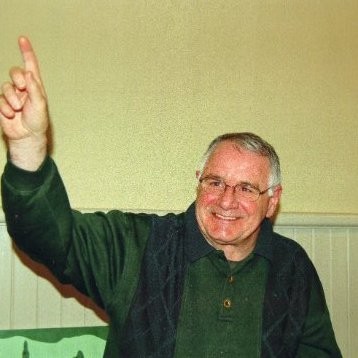

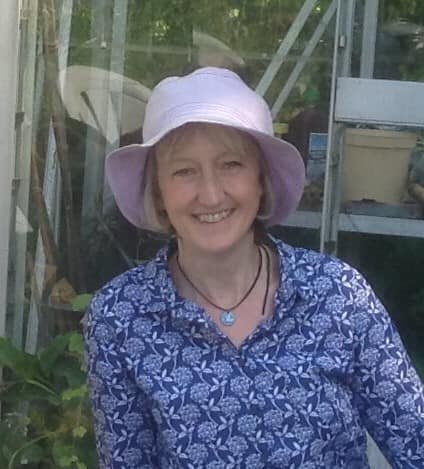
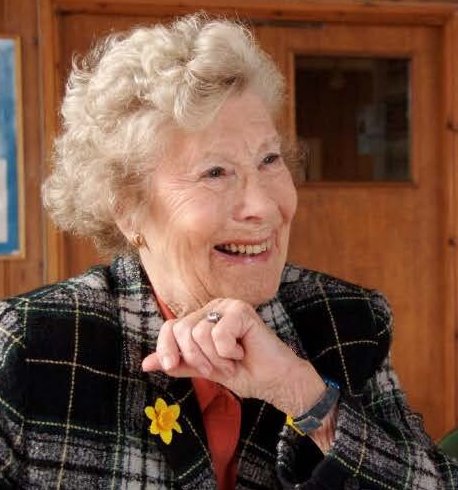

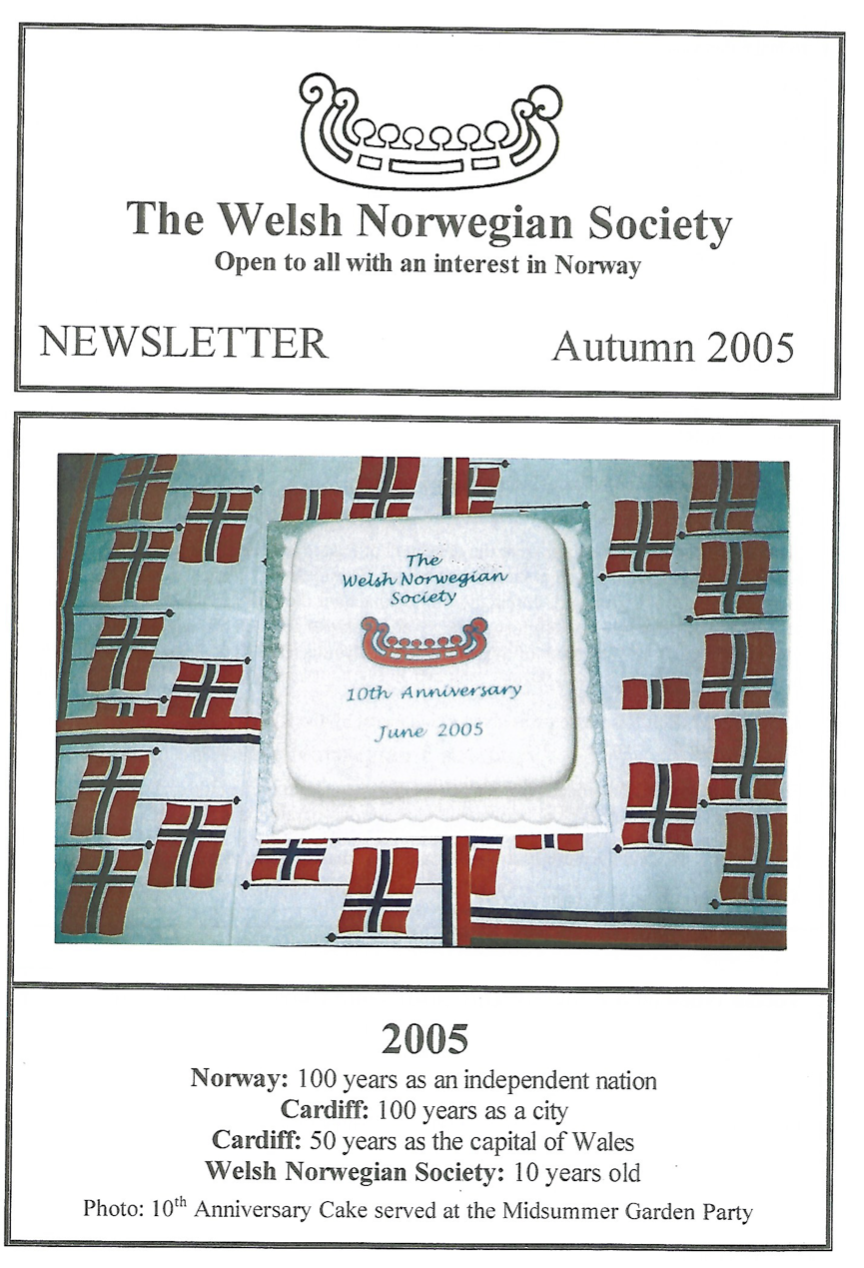
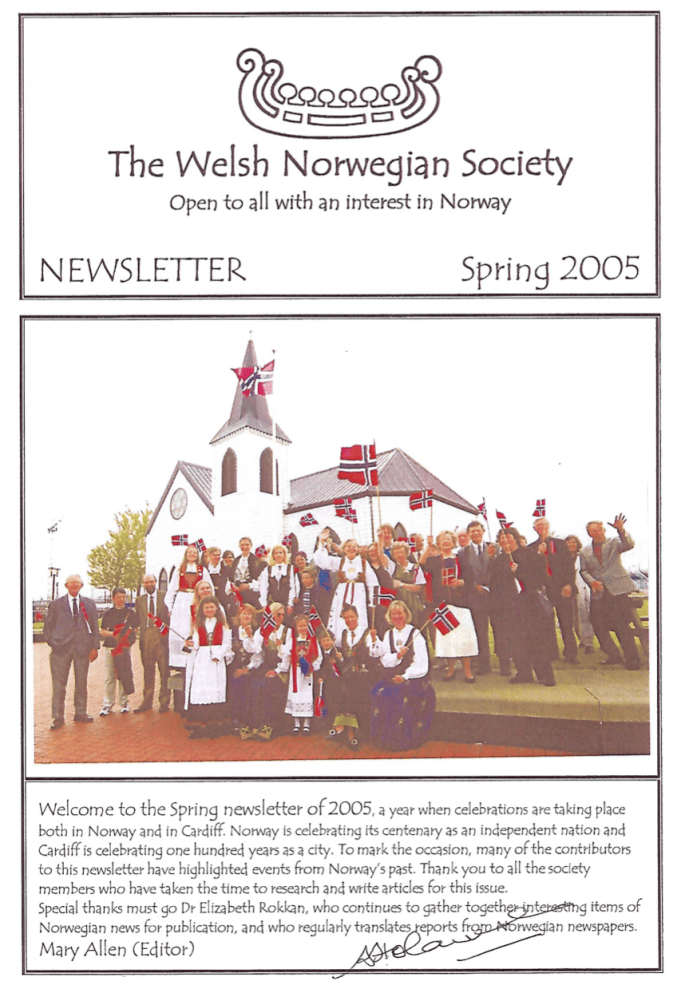

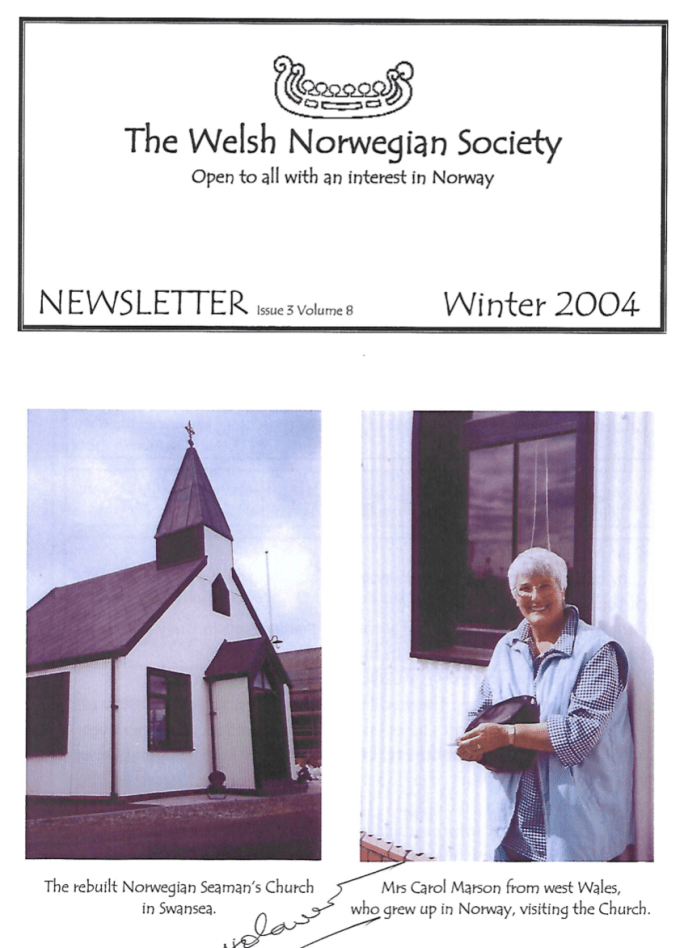

 Welsh Norwegian Society